Best Month to Visit Iceland in Winter 2026/27 (and the Worst)
February gives Reykjavík about 8.5 hours of daylight against December's four, which is why it wins. The honest month-by-month case, worst month included.
 Written with Björn Einarsson, Icelandic guide & winter tour specialist
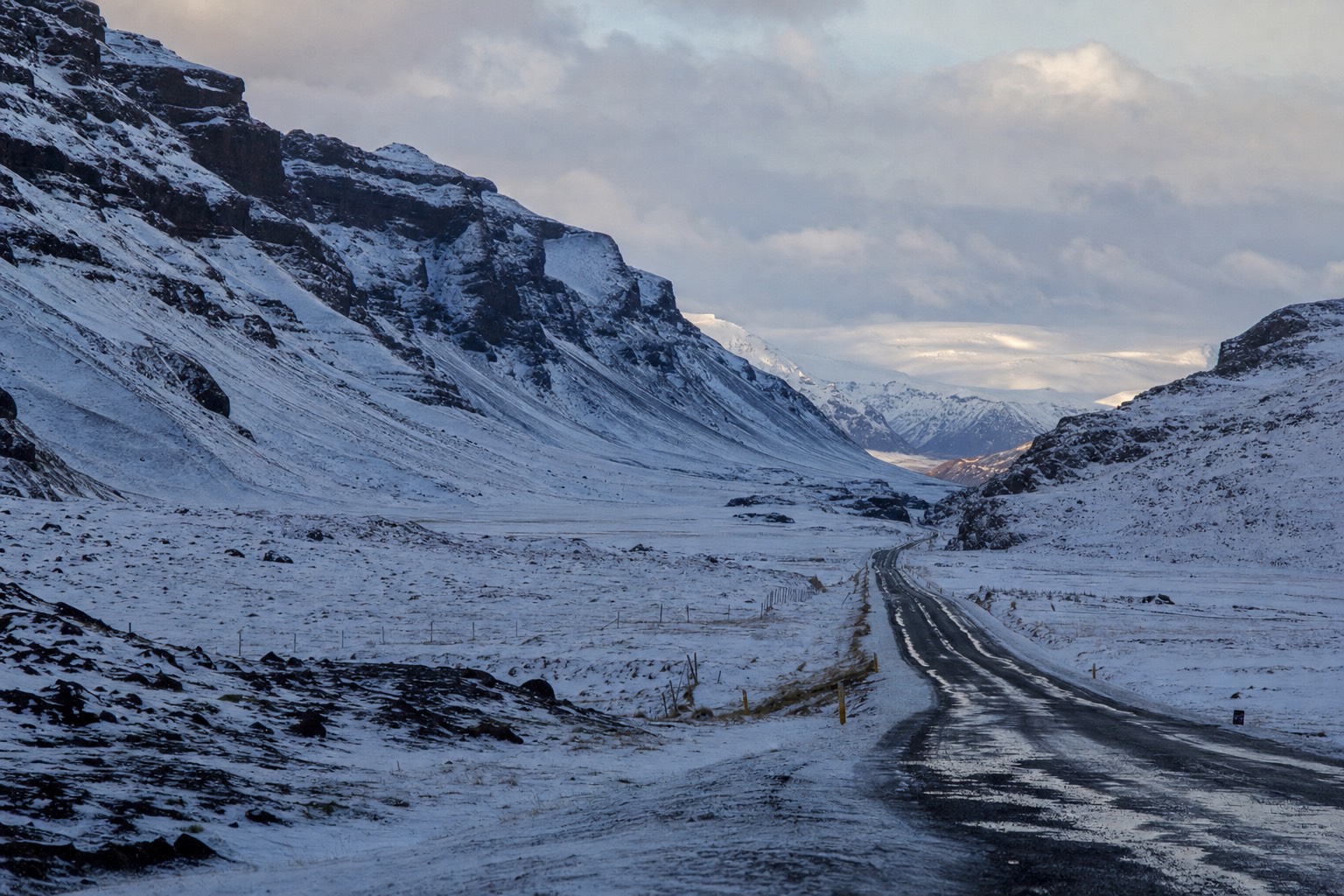
The question always arrives the same way, usually in an email in September: which month should we come? Then the follow-up nobody wants to answer, which is the more useful one. Which month should we avoid?
TL;DR: February for most people. About 8.5 hours of daylight, the aurora season still inside its strong stretch, and the ice caves open. January if the cave and the lights are the entire reason you are flying, because it sits in the deepest part of both seasons. December is the hardest month, at roughly four hours of light around the solstice, and March is the wrong month if you came for aurora and ice.
What is the best month to visit Iceland in winter?
February, for most visitors. Reykjavík gets about 8.5 hours of daylight, more than double December's four, while the aurora season is still in its strong October to February window and natural ice caves are open. You get the winter-only experiences without planning your whole day around a four-hour window of light.
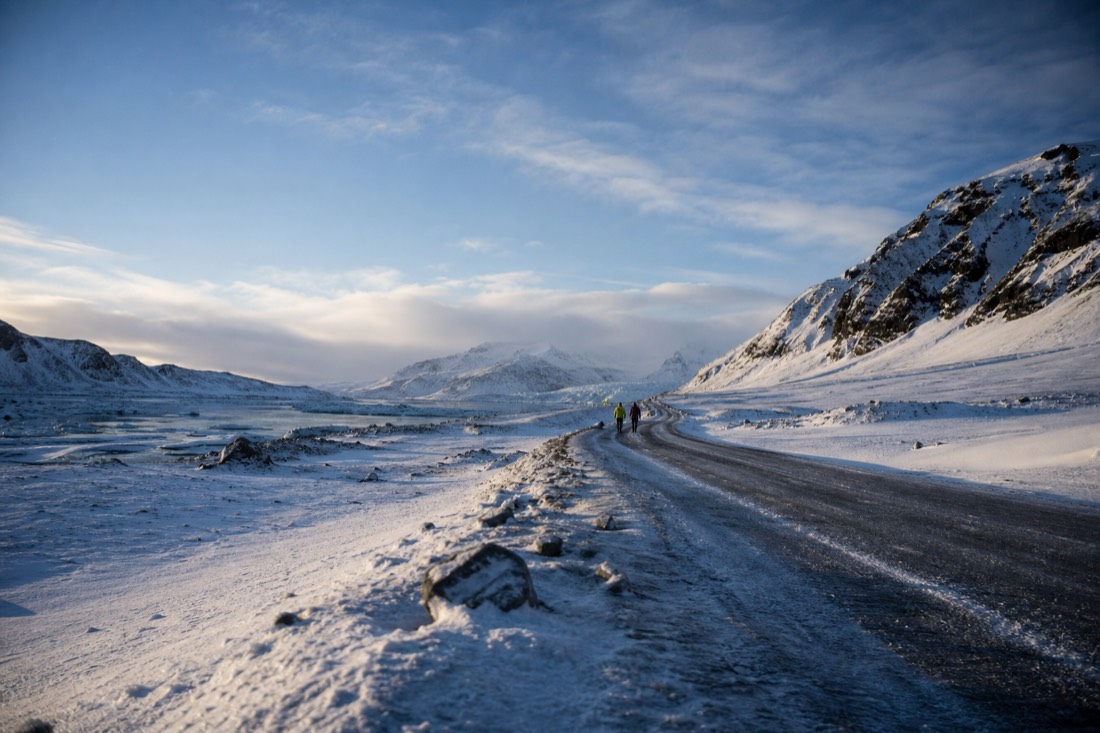
The defence of February is arithmetic before it is taste. Daylight is the constraint that decides how many things fit in a day, and 8.5 hours is the point where a two-stop day stops being a fantasy. You can do a South Coast run in real light, be back in Reykjavík for dinner, and still go out chasing the sky at ten. In December that sequence does not fit, because the light and the drive are competing for the same hours.
February also keeps everything on the menu. The caves are established by then rather than newly formed, the coast road is worked hard by the operators every day, and the aurora season has not started to fade. Nothing is closing yet.
The case against it is honest too: February is not the quietest month, and it is not the cheapest. If your priority is having Iceland to yourself, November does that better. If your priority is the strongest possible cave and aurora combination, January does that better. February wins because it loses least, which is exactly what most first trips need. The orientation guide to what an Icelandic winter actually allows covers the rest of the trade.
What's the worst month to visit Iceland?
December, if you measure by daylight. Around the solstice Reykjavík gets about four hours, so one long tour effectively is your day. March is the worst month for a different traveller: daylight returns, but natural ice caves are closing out and the aurora's strongest stretch has passed. The worst month is the one that mismatches your reason.
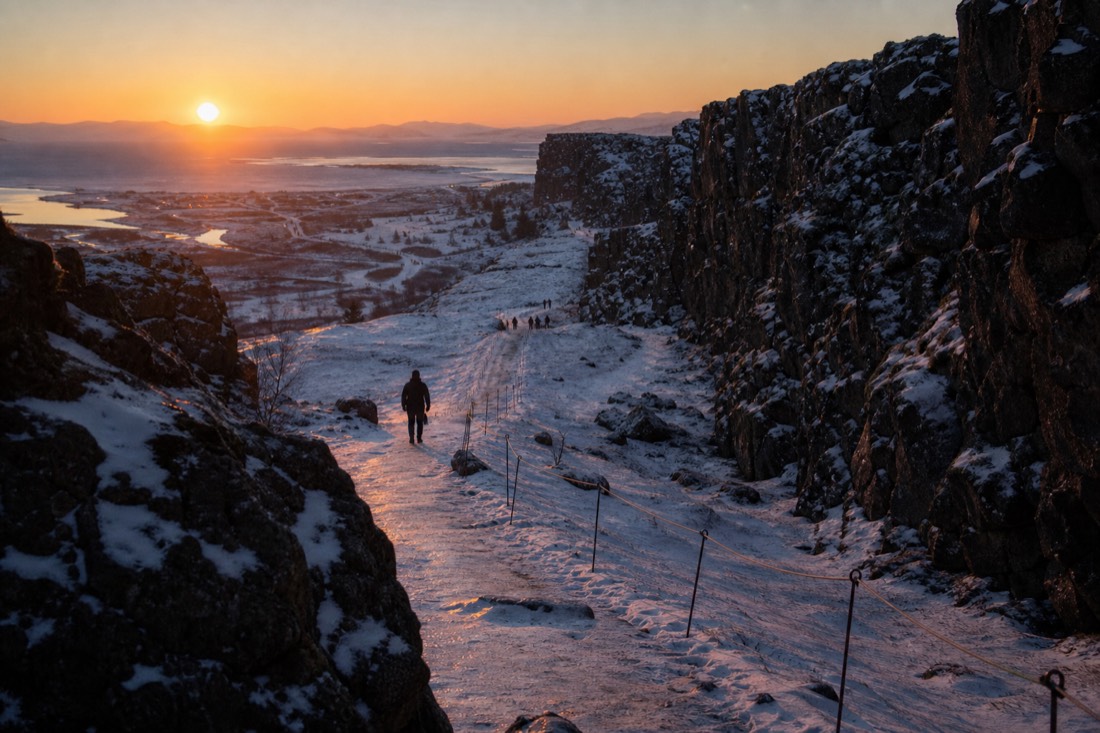
Almost nobody answers this honestly, so here it is. December's four hours are not a technicality. A 10 to 12 hour South Coast day in late December starts and finishes in darkness, and the middle of it is a long, low, orange half-light that photographs beautifully and schedules terribly. Add the holiday fortnight, when accommodation is in demand and dates behave unlike the rest of the season, and December asks the most from you.
I will not quote you a Christmas premium, because it varies by property and by year and any single number would be invented. What I will say is the practical version: over Christmas and New Year, price your accommodation before you price your flights, rather than the other way round.
March deserves its warning too. Roughly 11.5 hours of daylight sounds like a gift until you realise the natural ice caves are ending their season and the aurora is past its best window. You would be arriving for the winter experiences at the exact moment winter stops selling them. Early November has its own catch: the caves are only just being re-formed by the returning cold, so cave availability that early is the least predictable of the season. What people wish they had understood before booking is collected in what I wish I knew before my first Iceland winter, and month choice is the top of that list.
How much daylight does each winter month give you?
Reykjavík gets about 6.5 hours in November, about 4 at the December solstice, about 5.5 in January, about 8.5 in February and about 11.5 in March. Aurora season runs late August to late April and is strongest October to February. Natural ice caves run roughly November to March. Those three lines decide the month.
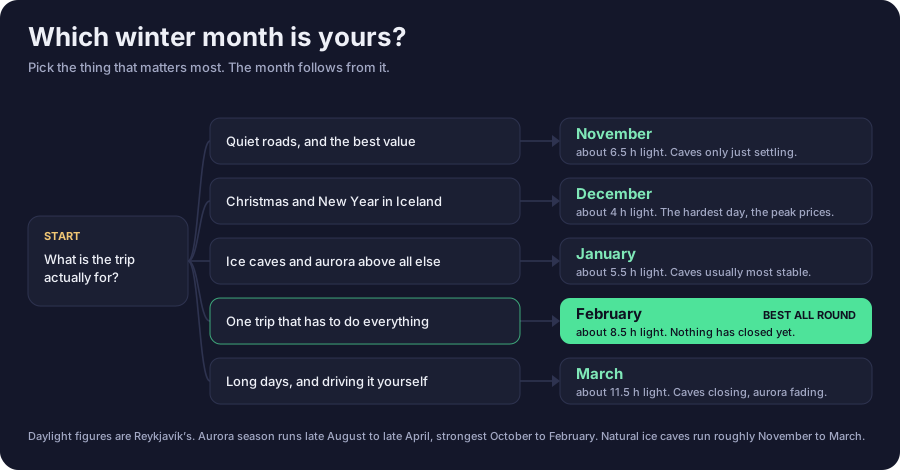
| Month | Daylight in Reykjavík | Aurora season | Natural ice caves | Verdict in one line |
|---|---|---|---|---|
| November | about 6.5 h | On, strengthening | Season opening, least predictable | Quiet and good value, caves still settling |
| December | about 4 h at the solstice | Strongest stretch | Open | Hardest daylight, and the holiday fortnight |
| January | about 5.5 h | Strongest stretch | Open and established | Best cave plus aurora month of the year |
| February | about 8.5 h | Still inside the strong window | Open | The all-round winner for a first trip |
| March | about 11.5 h | Fading toward the late April end | Closing out | Most light, least winter |
Read that grid downward rather than across. Daylight climbs steadily from the solstice, while the two winter-only experiences run in the opposite direction, weakest at the edges of the season and strongest through the middle. February is where the two lines cross in your favour. January is where the winter-only column is at its best and the daylight column is still hard.
One caveat the table cannot hold: none of this survives contact with a bad week. Any month can hand you five days of cloud and closed roads, which is why the morning check on road.is matters more than the month printed on your ticket.
Which month gives you the best northern lights odds?
October to February is the strong stretch, inside a season running late August to late April. December and January give the longest darkness, February gives usable evenings without the extreme short days. No month guarantees anything: you need solar activity and a gap in the cloud on the same night.
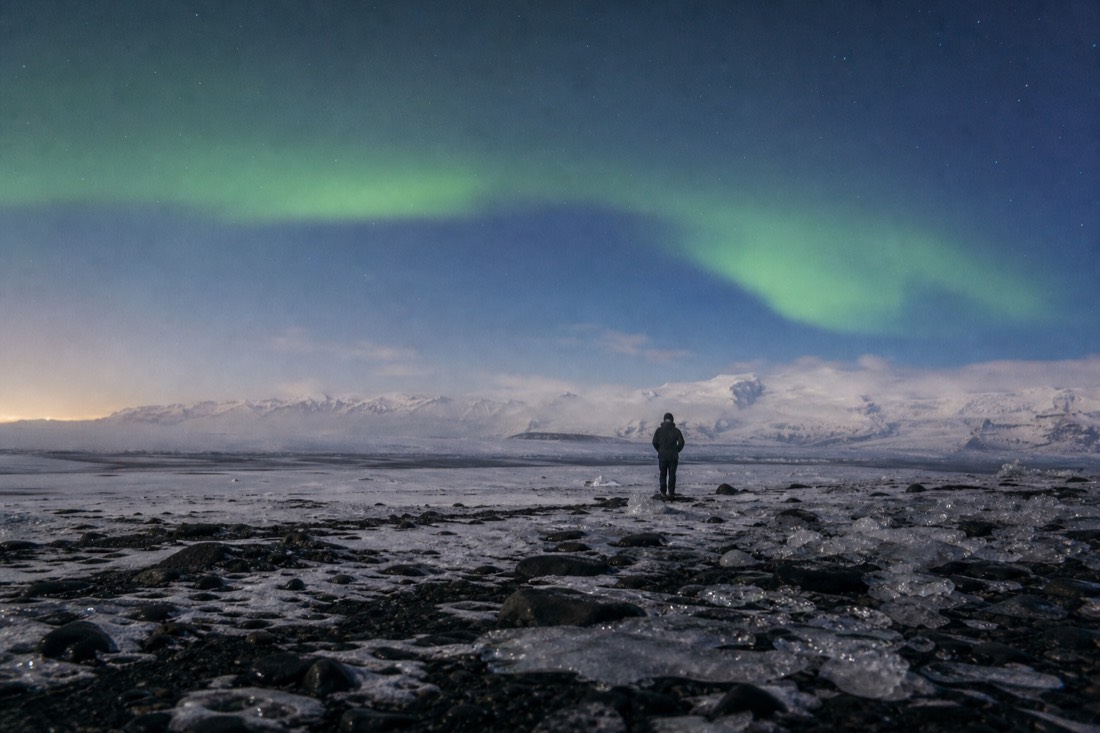
The month matters less than most planning guides suggest, and the number of nights matters far more. A four-night trip in the strongest month can be entirely clouded out, while three clear nights in late March will show you plenty. What each month really changes is the length of your window: in December the dark starts early and finishes late, so a tour has time to drive out from under the weather. Visit Iceland's official aurora page is refreshingly unsentimental about the whole thing.
That January-to-February jump of 28,000 visitors is the clearest picture of the trade you are making: January is meaningfully quieter, February is meaningfully brighter. If timing the lights is the whole project, the detailed guide to when to see the northern lights goes deeper into hours, cloud and how many nights to buy, and the northern lights tours page compares the four bookable runs.
When can you actually get inside a natural ice cave?
Roughly November to March. The caves are cut by meltwater and refreeze every cold season, so which ones exist changes year to year and no operator can promise a specific cave months ahead. Around 30 companies hold permits. The Langjökull tunnel is man-made and open all year, which is a different product.
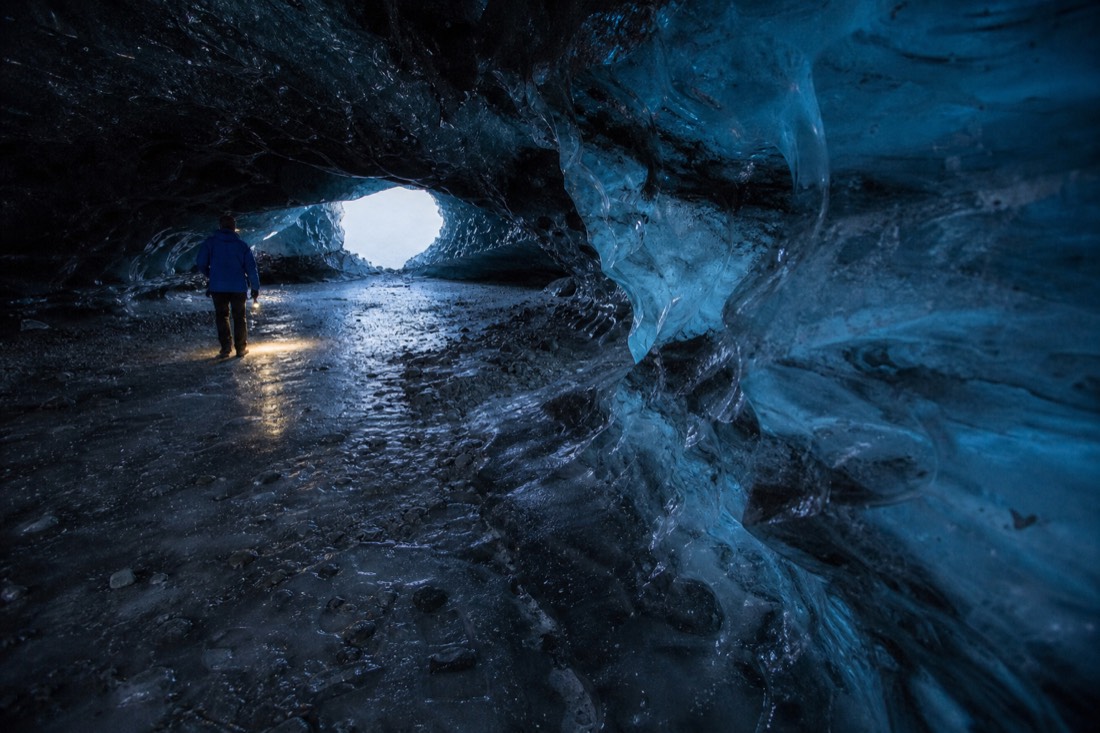
This is the fact that should decide your month if the cave is the point. A blue-ice chamber under Vatnajökull is not a permanent attraction with opening hours, it is a seasonal formation that the cold rebuilds and the thaw destroys. That is why guides re-scout every autumn and why the January and February caves tend to be the most stable ones of the season. Guide to Iceland's cave background sets out the formation cycle if you want the geology.
So if the cave is the reason you are coming, book it properly rather than hopefully. The Vatnajökull and Katla ice cave page compares the real options, and the Jökulsárlón cave tour, at 4.2 across 2,171 GetYourGuide reviews, is available to check for your dates on GetYourGuide.
One logistical point that changes the month calculation. Jökulsárlón is about 380 km from Reykjavík, roughly five hours each way, and in December or January both legs would be driven in the dark. In those two months especially, a two or three-day winter package is the rational choice rather than the indulgent one, because it converts ten hours of night driving into a night near the ice.
Is Christmas or New Year worth the money?
It depends what you are buying. The holiday fortnight sits at the darkest point of the year, roughly four hours of daylight, with accommodation in its highest demand of the winter. If you want Reykjavík in full festive mode, it delivers. If you want to see the country, almost any other winter fortnight gives you more.
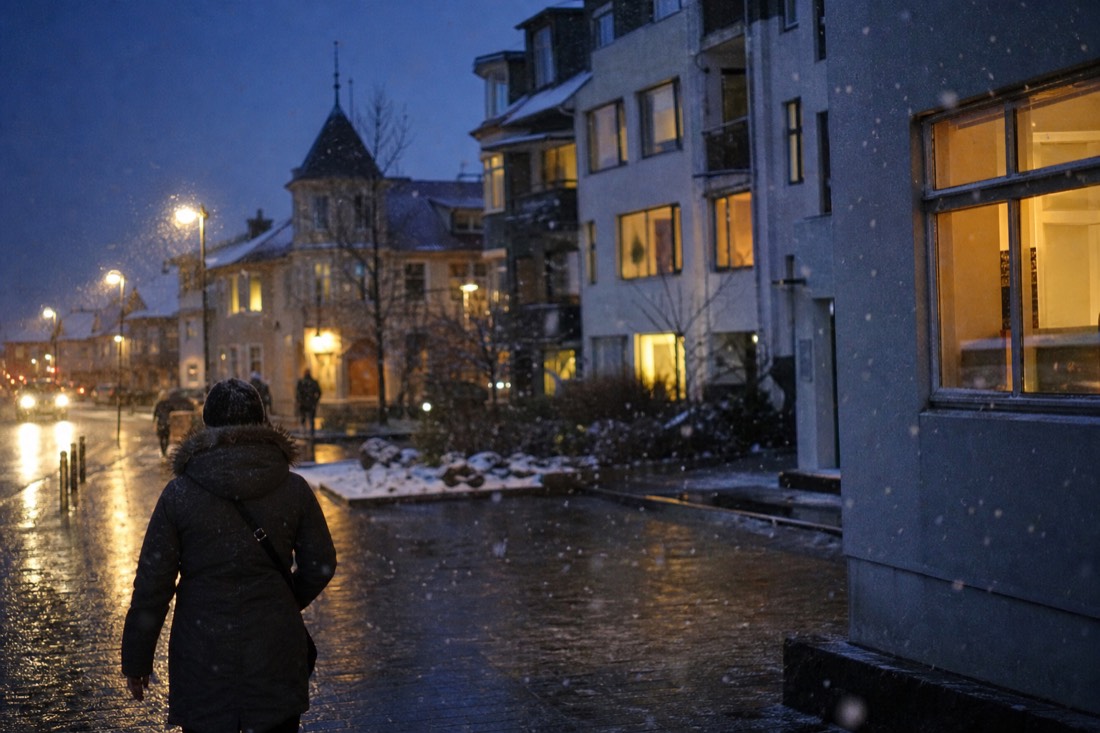
There is a version of this trip that works. Two or three nights in Reykjavík over the holidays, one short tour, the lagoons, and no expectation of covering ground. The city does the season properly, and the darkness that ruins itineraries makes the lights in the streets look better than they have any right to.
The version that does not work is the ambitious one. People book the holiday fortnight and then try to fit the South Coast, the Golden Circle, an ice cave and Jökulsárlón into it, and they end up watching most of Iceland go past a dark bus window. The daylight will not stretch.
If you have already committed to those dates, plan them as a December trip rather than a generic winter one, which is a different exercise. The dedicated December guide works through what actually fits in four hours of light.
What is open and what is shut, month by month?
Natural ice caves run roughly November to March. Highland F-roads are shut the entire winter, in every month, without exception. Studded tyres are legal 1 November to 15 April. Whale watching from Reykjavík and Silfra snorkelling run year-round. Nothing on the list closes because of cold alone.
| Feature | Nov | Dec | Jan | Feb | Mar |
|---|---|---|---|---|---|
| Natural ice caves | Opening | Open | Open | Open | Closing out |
| Aurora season | Strong | Strongest | Strongest | Strong | Fading |
| Highland F-roads | Closed | Closed | Closed | Closed | Closed |
| Studded tyres legal | From 1 Nov | Yes | Yes | Yes | Yes |
| Whale watching, Reykjavík | Yes | Yes | Yes | Yes | Yes |
| Silfra snorkelling | Yes | Yes | Yes | Yes | Yes |
| Daylight above 8 hours | No | No | No | Yes | Yes |
The row people misread is the F-roads. Every winter somebody plans a Landmannalaugar detour in February and discovers the interior is not a seasonal maybe, it is closed. The row people underrate is Silfra: a drysuit makes the water temperature irrelevant, so the best-scoring experience on this site is available in the darkest month of the year.
Weather cancellations sit outside this table entirely. Operators reschedule or refund their own weather calls, and every listing here allows free cancellation up to 24 hours ahead, with one exception, the Blue Lagoon admission with transfers, which needs 2 days. The full terms are on the FAQ page.
How busy does each winter month feel, and where does the pressure land?
Crowding in an Icelandic winter is not spread evenly across the country, it concentrates in a few places: fixed-capacity tours, weekend hotel rooms in Reykjavík, and the holiday fortnight. January took 119,000 foreign arrivals through Keflavík in 2026 against February's 147,000, and that gap is felt on departures rather than at waterfalls.
The useful mental model is that Iceland's winter sites are enormous and its vehicles are not. Seljalandsfoss does not run out of space in February. A super jeep with room for a fixed number of people at an ice cave absolutely does, and so does a small-group minibus on the South Coast, and so does a decent room in the centre of Reykjavík on a Saturday in the holiday weeks. When people describe a winter month as busy, they are almost always describing one of those three things.
| Month | How busy it feels on the ground | Where the pressure actually lands | What to book furthest ahead |
|---|---|---|---|
| November | The quietest stretch before the holidays | Very little, other than weekend rooms | The ice cave, because early-season availability is the least predictable |
| Early December | Still calm, city filling up slowly | Restaurant tables as the office parties start | Nothing unusual |
| Christmas and New Year | The peak of the whole winter calendar | Rooms, restaurants and the popular departures at once | Accommodation first, then everything else around it |
| January | The quietest of the peak-season months | Ice cave departures only, because capacity is fixed | The cave, and only the cave |
| February | Noticeably fuller than January | Small-group products, half-term weeks, weekend rooms | Cave and any small-group tour |
| March | Busier again as daylight returns | The classic day tours as coach loads increase | Nothing, if you are flexible on days |
Read the right-hand column rather than the second one, because that is where the money and the disappointment are. Almost nobody fails to see Gullfoss in winter. Plenty of people fail to get on the specific cave tour they wanted, in every month of the season, because around 30 companies hold ice cave permits and the total number of seats behind those permits is small compared with the number of people who want one.
Price behaves differently from crowding. It moves hard across the holiday fortnight and much less between, say, January and February, so choosing a month to save money is a weaker lever than most people assume. The numbers that actually decide a winter budget are broken down in what an Iceland winter trip costs, and the one line that reliably surprises people is accommodation rather than tours.
November or March: which edge of the season is the better compromise?
They fail in opposite directions. November gives you a quiet country and a full aurora season but the least predictable ice caves, since the freeze is still forming them. March gives you about 11.5 hours of daylight and easier roads while the caves are closing out and the aurora peak has passed. Pick the one whose weakness you can live with.
These two months get lumped together as shoulder season, which hides the fact that they are almost mirror images. Both sit at the edge of the winter product range. Both are cheaper and calmer than the middle of the season. What separates them is which half of the winter menu is still on offer, and that turns out to matter more than any amount of price difference.
| The question | November | March |
|---|---|---|
| Daylight in Reykjavík | About 6.5 hours | About 11.5 hours |
| Aurora season | On and strengthening, inside the strong stretch | Inside the season, past the strongest stretch |
| Natural ice caves | Season opening, availability least predictable | Season closing out |
| Driving conditions | Winter arriving, studded tyres legal from 1 November | Winter loosening, though storms still happen |
| Crowds | The pre-holiday lull, the quietest month of the five | Filling up again with the returning light |
| Who it suits | Someone who wants the country empty and the nights long | Someone who wants to cover ground and see it |
| The thing that can ruin it | A cave that has not formed yet | A cave that has already closed |
The bottom row is the one to decide on. If a natural ice cave is on your list and cannot be dropped, neither of these months is your first choice, and you should be looking at January or February instead. If the cave is optional, both edges are good value, and November in particular is the closest thing to having the classic sites to yourself.
There is a third factor that the table cannot hold, which is what you want the trip to feel like. November is a dark, quiet, inward sort of month where the natural rhythm is one thing a day and a long evening. March is the opposite: the light comes back fast, the country reopens visually, and it starts to feel like a place you could drive across rather than one you visit in fragments. Neither is better. They are different holidays wearing the same coat.
How far can you realistically get from Reykjavík in each month?
Daylight sets your reach more than road conditions do. With about four hours of light in December, anything past roughly two hours' drive is seen in the dark. By February's 8.5 hours the South Coast opens up properly, and by March's 11.5 you can move between towns and still see the country you are driving through.
Iceland's winter distances are not long by the standards of a road atlas and are very long by the standards of a short day. Vík sits about 190 km from Reykjavík, Jökulsárlón about 380 km, and neither number changes with the season. What changes is how much of that road you actually see, and whether the return leg happens in a headlight tunnel or in daylight.
| Month | Daylight in Reykjavík | What you realistically see in the light | The trip shape that fits |
|---|---|---|---|
| November | About 6.5 h | Golden Circle comfortably, South Coast in part | Reykjavík base, one anchor a day |
| December | About 4 h at the solstice | One cluster of stops, and not much of the road | Reykjavík base, evenings for aurora and lagoons |
| January | About 5.5 h | Golden Circle, or the western half of the South Coast | Reykjavík base, or a guided package to reach the east |
| February | About 8.5 h | A full South Coast day, most of it visible | A night out of the city starts paying for itself |
| March | About 11.5 h | Long linear routes, seen end to end | Moving between towns becomes reasonable |
The row people fight hardest against is December, and the argument is always the same: the map says five hours to the glacier lagoon each way, so surely it is doable. It is doable in the sense that the car will get there. It is a bad day in every other sense, and it is the single strongest argument for handing the driving to a two or three-day winter package in the darkest months, since that converts ten hours of night driving into a night spent near the ice.
Two things sit outside this arithmetic entirely. The highland interior is closed in every month of the winter, so no amount of daylight opens it. And a storm compresses your reach regardless of the calendar, which is why the check on road.is on the morning of a drive outranks anything you planned from home. Where to base yourself given all of that is worked through in where to stay in Iceland in winter.
Björn's honest ranking of the winter months
February first, January second, November third, March fourth, December last on daylight alone. That ranking is for a first trip built around the winter-only experiences. Change the reason for coming and the order changes with it, which is why the ranking is less useful than the reasoning behind it.
Björn has guided professionally since 2020 and has worked the South Coast and glacier country since 2022, for more than a thousand international travellers by his own count. He does not run any of the departures this site links to, and the ranking above is the answer he gives when somebody asks him over coffee rather than a scoring system with anything behind it.
His reasoning is simple enough to argue with. February wins because it fails at nothing: the caves are open, the aurora is still in its strong stretch, and there is enough daylight to make a long day worth the coach seat. January comes second because it wins on the two winter-only things and loses three hours of light doing it. November is third on value and quiet, and would be second if the cave season were reliable that early. March is fourth because it delivers a beautiful country and the wrong half of the winter menu. December is last only if you are trying to see Iceland, and first if you are coming for Reykjavík in the dark with the lights on.
The pattern he sees go wrong is not month choice at all. It is people picking a month for one reason and then building an itinerary that needs a different one. Somebody chooses December for the Christmas markets and then books a Jökulsárlón day trip. Somebody chooses March for the daylight and then puts an ice cave at the centre of the week. The month is a promise about what is available, and the itinerary has to accept it rather than argue.
If you take one thing from all of this, take the tiebreak rather than the ranking. Decide the one experience you would be genuinely upset to fly home without, then pick the month that protects it, and let everything else be a bonus you probably get anyway. For most people that experience turns out to be a natural ice cave rather than the lights, which quietly settles the argument in favour of the middle of the winter.
Which month fits your reason for coming?
Pick the month that matches your one non-negotiable. Ice cave plus aurora, take January. First trip covering the classics, take February. Quiet and cheap, take November. Daylight and driving, take March. Reykjavík at Christmas, take December and keep your ambitions inside the city.
| What you came for | Month | Why | What you give up |
|---|---|---|---|
| Ice cave and aurora above all | January | Deepest part of both seasons, quieter than February | Only about 5.5 hours of daylight |
| A first trip covering the classics | February | About 8.5 h of light with everything still open | Not the cheapest or quietest month |
| Quiet, low-season Iceland | November | Roughly 6.5 h of light and the pre-holiday lull | Cave season still settling in |
| Daylight and long drives | March | About 11.5 h, roads improving | Caves closing, aurora fading |
| Reykjavík in festive season | December | The city does the darkness well | About 4 h of light, holiday demand |
| Low-sun photography | December or January | The sun barely climbs, so the light stays golden | Everything takes longer |
If two rows describe you, the tiebreak is simple. Whichever experience you would be most upset to miss decides the month, and the other one becomes a bonus you might get anyway.
Once the month is settled, the planning question changes shape entirely. Booking order, daylight budgeting and which tours to hold back as bad-weather insurance are month-specific problems, and the February planning guide handles the winner in detail.
Jökulsárlón: Vatnajökull Ice Cave Guided Tour
Settled on your month? Check the cave dates for it before anything else on the list: the season decides availability more than the calendar does, and the listing cancels free up to 24 hours out.
2.5 to 3 hours · English
Check travel dates with GetYourGuide below.
None of these experiences matches that choice. Adjust your preference or reset to the general recommendation.
Compare Options And Plan Your Trip
- February, the all-round first trip
- 8.5 hours of light fits the full South Coast day.
- January, cave and aurora above all
- Deepest part of both seasons; the Jökulsárlón cave is the anchor booking.
- November, quiet and long nights
- Pre-holiday lull with the aurora season on; a 19-seat night uses the darkness.
- December, festive and short-dayed
- The half-day Golden Circle fits the four hours you actually have.
- March, daylight and open roads
- The small-group South Coast day in real light, 4.8 across 6,418 Viator reviews.
Before Booking