Inside a Vatnajökull Crystal Ice Cave
Around 30 companies hold ice cave permits in Iceland, and none of them can promise you the same cave twice. What the walk in, the blue and the noise are really like.
 By Björn Einarsson, Icelandic guide & winter tour specialist
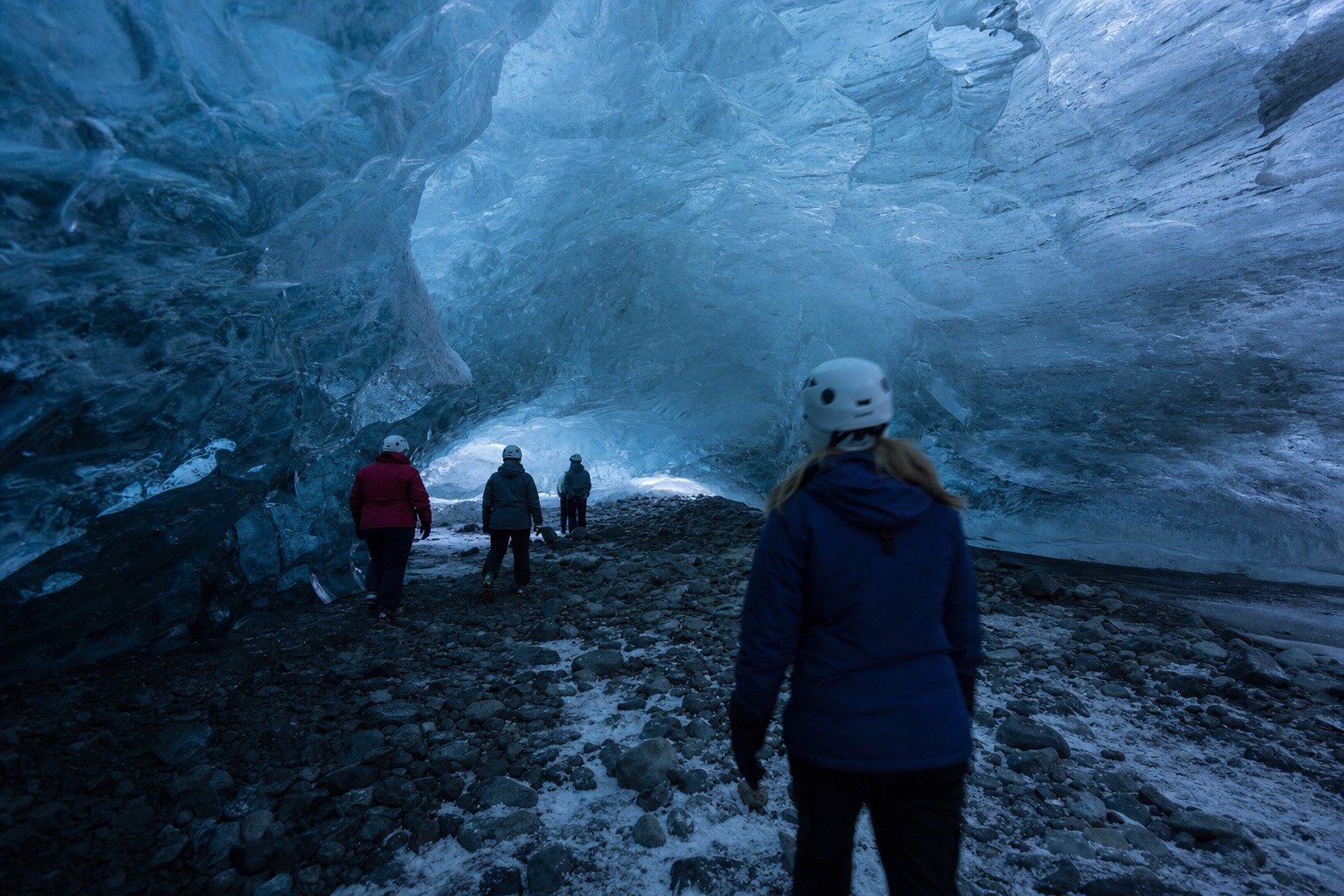
The sound is what nobody puts in the photographs. A glacier is not silent, and inside a cave under Vatnajökull you hear it working: meltwater running somewhere behind the wall, the occasional dull crack that travels through the ice rather than the air, and the crunch of eleven pairs of crampons on a floor that was a river in August.
TL;DR: the cave is real, the blue is real, and the day around it is longer than the cave visit. You meet a super jeep off the ring road, bump up a moraine track for twenty or thirty minutes, walk a short way over rubble and ice, and spend perhaps forty minutes underground. Every natural cave is temporary. The one you stand in this January will be gone or unrecognisable by next winter.
What is it actually like inside a Vatnajökull ice cave?
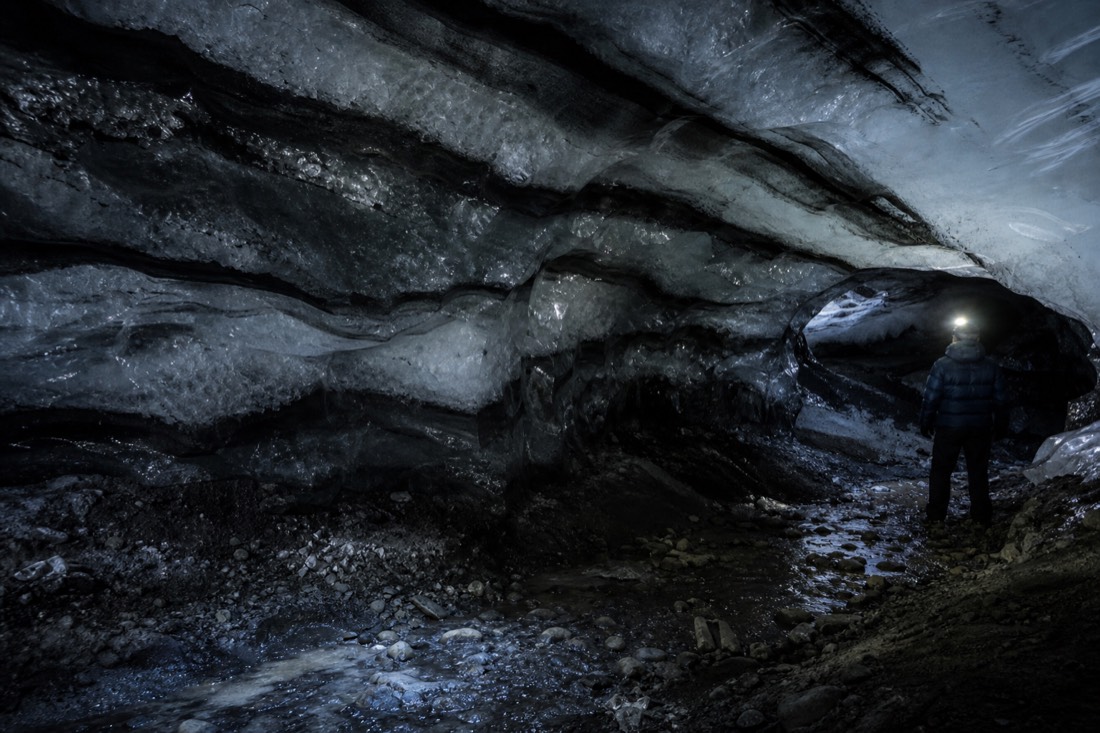
Colder and quieter than you expect, and smaller. Most crystal caves hold one group at a time in a chamber the size of a large room, with a low ceiling of translucent ice, a gritty floor and a blue that intensifies as your eyes adjust. Forty minutes inside is a normal visit.
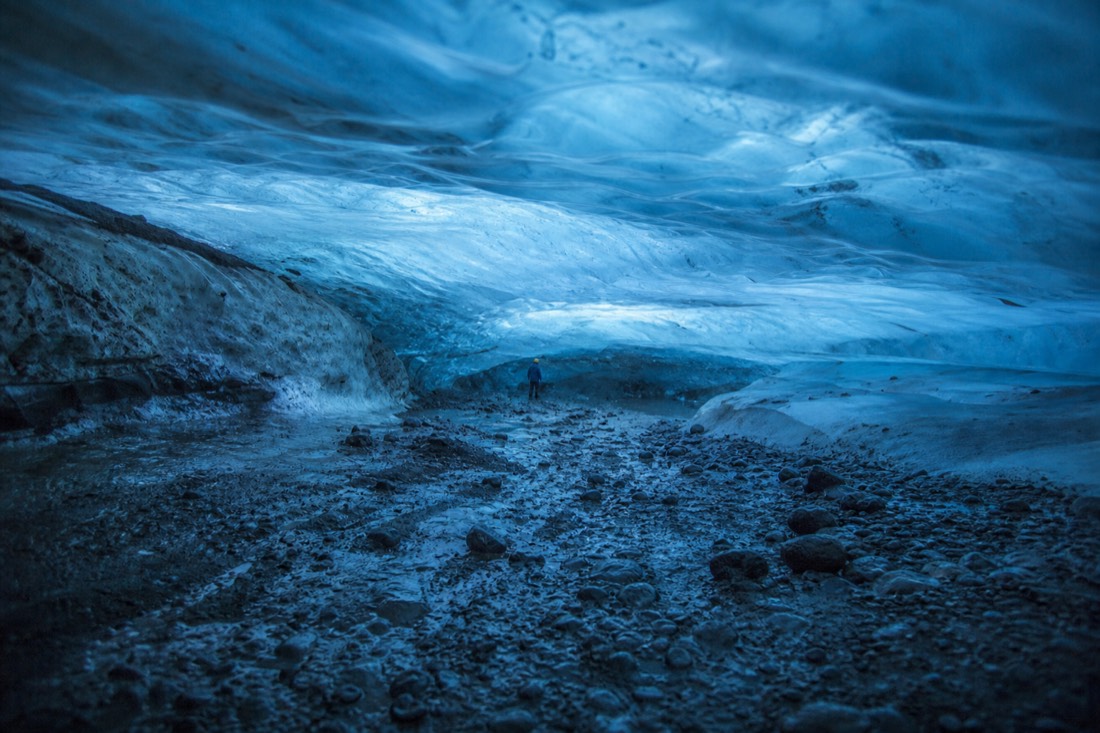
The first reaction is almost always the wrong one. People walk in, look up, take a photograph, and decide it is nice. Then they stand still for five minutes and the cave changes: the eye adapts, the blue deepens, and details appear in the ceiling that were invisible on arrival. The visitors who get the most out of it are the ones who stop shooting after two minutes.
Underfoot is not smooth ice. It is usually a mix of glacial silt, gravel and hard ice with a rough surface, which is exactly why crampons come out of the back of the jeep before you go anywhere near the entrance.
You will also see the glacier's dirt. Ash bands from old eruptions, black grit frozen into the walls, a stripe of volcanic sediment that dates a bad summer decades ago. That is not a flaw. It is the record of the thing you are standing inside.
How do you actually get to the cave?
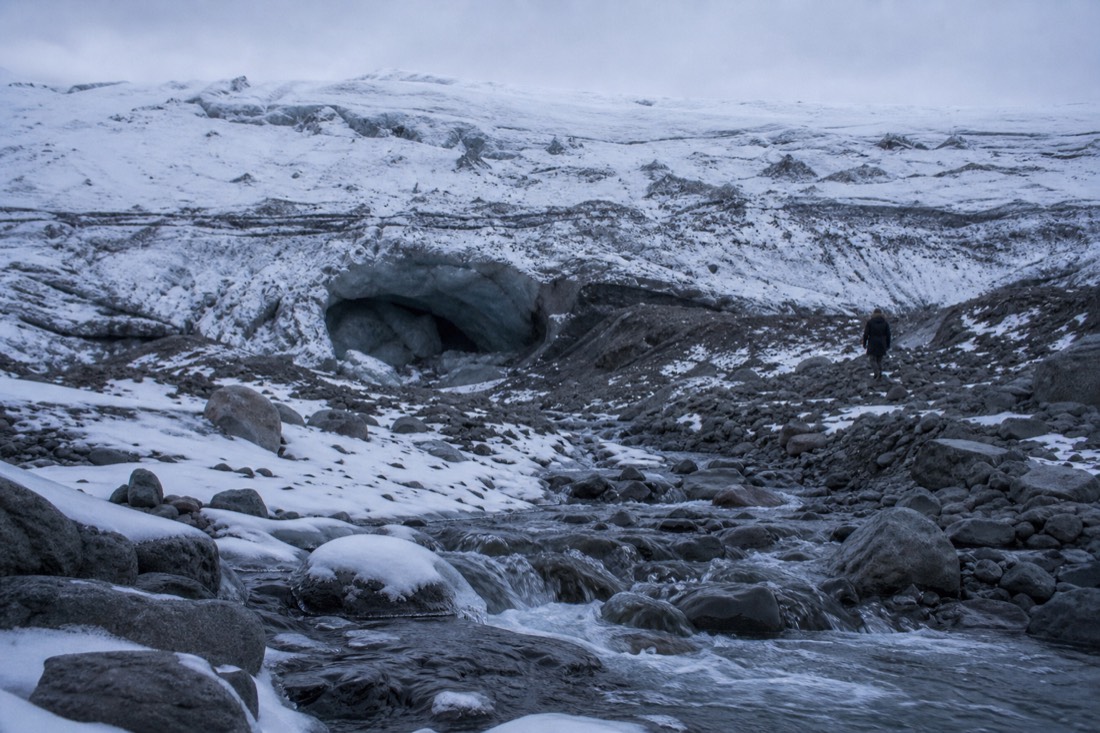
You do not drive to it. Tours meet at a car park near Jökulsárlón, transfer everyone into a modified super jeep, and grind up a rough moraine track for twenty to thirty minutes. From the drop-off there is a short walk over uneven ground to the entrance, usually ten to twenty minutes.
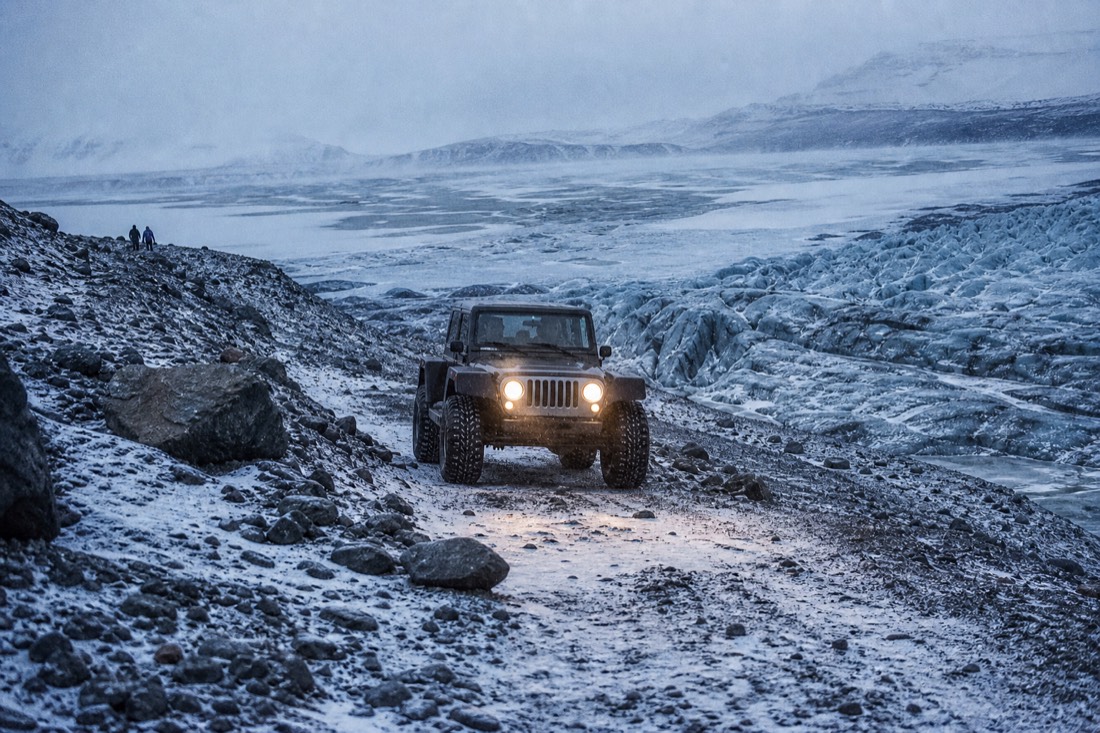
That transfer is not showmanship. The tracks onto the glacier margin are unmarked, they change with the meltwater, and they need clearance and tyres a hire car does not have. Attempting the approach in a rented SUV is how people end up on the wrong side of a washout in the dark.
The bigger logistical fact is the distance. Jökulsárlón is about 380 km from Reykjavík, roughly five hours each way, so in January both legs of a day trip run in full darkness. That is the whole case against doing this as a single day from the capital.
| How you reach the cave | Travel time from Reykjavík | What it costs you | Who it suits |
|---|---|---|---|
| Day trip from Reykjavík | About 5 h each way | A 14 to 16 hour day, both drives in the dark | The determined, on a short trip |
| Two-day South Coast package | Overnight on the South Coast | Two days, one hotel night | Most people, honestly |
| Three-day winter package | Spread over three days | Three days, cave plus aurora plus Golden Circle | Anyone with the time |
| Self-drive to the meeting point | You drive, then transfer | The drive plus a winter road risk | Confident winter drivers only |
Jökulsárlón sitting five hours out each way is exactly why this is the one trip where a multi-day winter package is the sane call rather than the expensive one. The 3-day Troll Expeditions run rates 4.9 across 677 Viator reviews, and the two-day South Coast and blue ice cave version sits at 4.7 across 261 GetYourGuide reviews.
Why is the ice blue?
Because glacier ice at depth has had its air squeezed out of it. Dense, bubble-free ice absorbs the red end of the light that enters it and lets the blue through, so what reaches your eye is what the ice failed to swallow. Fresh snow looks white for the opposite reason.
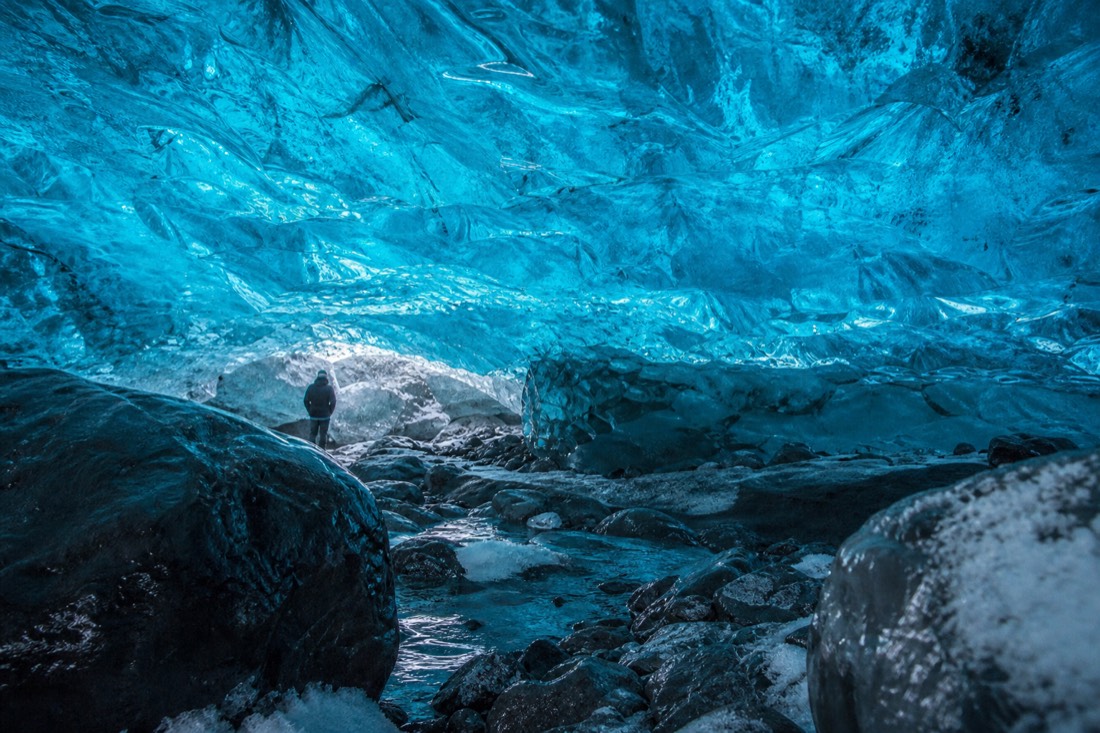
The practical version is that the blue depends on the ice, the light outside and the thickness of the roof above you. A thin ceiling on a bright day glows almost turquoise. A thick one on a grey afternoon reads deep navy and photographs badly. Guides know which chambers hold their colour in flat light, which is a real skill and not a marketing line.
Fresh snow on the surface changes everything too. A dump overnight can mute a cave that glowed the previous week. Nobody controls this, which is why honest operators describe the colour in ranges rather than promising a specific shade.
Will the cave I visit this winter still exist next winter?
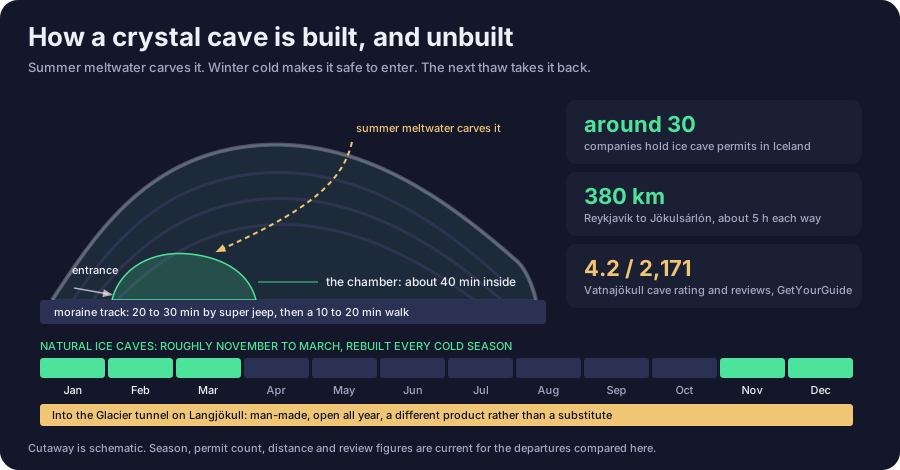
Almost certainly not, at least not as the same cave. Natural ice caves are carved by summer meltwater and refreeze when the cold returns, so which caves exist, where they are and how big they are changes from year to year. Operators scout new ones every autumn.
This is the part the photographs on booking sites cannot express. That famous image of a cathedral-sized blue chamber may be from three winters ago, and the cave in it may have collapsed the following spring. A responsible listing says so. The ice cave season background from Guide to Iceland covers the same ground from the geological side.
So the honest expectation to arrive with is this: you are booking access to whatever the glacier built this year, guided by people who found it and checked it. If you need the exact cave in the picture, you are going to be disappointed by a natural feature doing what natural features do.
The season itself runs roughly November to March. Outside that window the meltwater is running again and the caves are unsafe, which is why summer visitors get the man-made tunnel instead.
How hard is it, and what do you need to wear?
Not hard. The walk is short and mostly flat, but the ground is uneven and you will be in crampons for part of it. Operators supply the crampons, helmet and usually a harness. You supply waterproof trousers, warm layers and boots stiff enough to take a crampon strap.
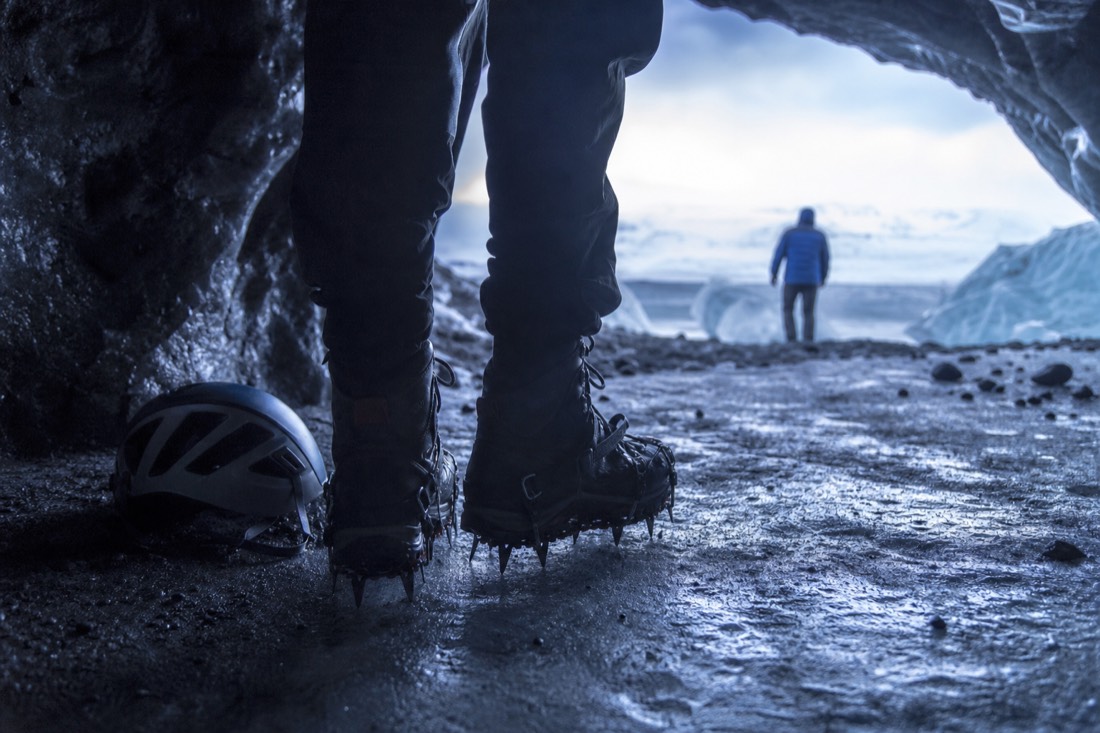
The kit failure I see most often at the meeting point is footwear. Trainers cannot hold crampons, and soft ankle boots are little better. If you do not own proper hiking boots, most operators rent them, and it is worth the extra step rather than being turned away at the jeep.
| Item | Who provides it | Why it matters |
|---|---|---|
| Crampons | The operator | The floor is hard ice with grit on it |
| Helmet | The operator | Low ceilings and the occasional falling shard |
| Harness | Usually the operator | Used on steeper entrances, not every cave |
| Waterproof trousers | You | You will kneel, and the floor is wet |
| Stiff hiking boots | You, or rent locally | Crampons will not stay on trainers |
| Headtorch | You, optional | Useful in the last hour of a January afternoon |
Groups are usually mixed in age and fitness, and guides pace to the slowest person. Where the real filter sits is the minimum age set on each listing, which varies by operator and by cave, so read the one you are booking rather than assuming.
Jökulsárlón, Katla or the man-made tunnel?
Three different products. The Vatnajökull crystal caves near Jökulsárlón are the classic blue-ice experience and the furthest away. The Katla cave under Mýrdalsjökull is closer to Vík and darker, with volcanic ash in the walls. The Langjökull tunnel is man-made, open all year, and not a natural cave at all.
| Cave | Base | Season | What you get | Rating |
|---|---|---|---|---|
| Vatnajökull crystal cave | Jökulsárlón | Nov to Mar | The blue chambers, 2.5 to 3 h on site | 4.2 across 2,171 GYG reviews |
| Katla ice cave | Vík area | Longer season than the crystal caves | Black ash bands, super jeep approach | 4.7 across 1,172 Viator reviews |
| Into the Glacier tunnel | Langjökull | All year | A drilled tunnel, reliable and man-made | A different product entirely |
If the crystal cave is the reason you are coming to Iceland at all, book that one specifically rather than a generic "ice cave" line item: the Vatnajökull ice cave tours page compares the real departures, and the highest-volume of them is available to check for your dates on GetYourGuide.
Which of the four fits your particular trip, budget and driving confidence is worked through properly in which ice cave tour is best in Iceland.
What does the safety briefing actually cover?
Six things, and every one of them exists because of something that happened somewhere. Helmets on before you approach the entrance, one route in and one route out, nobody touches the ceiling, nobody walks past the guide, everyone counted in and counted out, and if the guide says leave, you leave without finishing the photograph.
The briefing usually happens at the vehicle rather than at the cave, which catches people out because they are still fiddling with gloves and not listening properly. Listen anyway. It is short, it is not a legal ritual, and the parts that sound like fussing are the parts that are not.
The line about noise is the one people misread. When a guide asks a group to stop talking for a minute inside a chamber, most visitors assume it is for atmosphere, or so somebody can take a clean video. It is neither. The guide is listening. Ice makes a specific set of sounds when it is doing something you would rather it did not, and a chattering group of twelve masks all of them.
| What the briefing says | Why that line exists |
|---|---|
| Helmet on before you leave the vehicle | The hazard starts at the entrance lip, not in the chamber |
| Walk the line the guide walks | That ground has been checked. The ground a metre either side has not |
| Do not lean on or touch the ceiling | Ice sheds when it is disturbed, and hands do the surface no favours |
| Nobody enters or leaves alone | A count in and a count out is how nobody gets left in the dark |
| Quiet when asked | The guide is listening to the cave, not enforcing reverence |
| If the call is out, go out now | By the time it is spoken, the decision has already been made |
You can judge an operator on how it delivers all that, which is the same test I apply everywhere and set out in who actually runs these Iceland tours. A guide who recites it flatly with their back to the group is telling you something. So is one who stops and checks that the person at the back with the hearing aid actually caught it. The departures compared on the ice cave tours page all do the briefing. They do not all do it the same way.
What is the super jeep drive actually like?
Slow, loud and much rougher than a road. The modified vehicles run oversized tyres at low pressure so they float over soft ground instead of digging in, which means a lot of pitching and rolling at not much more than walking pace. Twenty to thirty minutes of it, each way.
The bit that surprises people is watching the driver let air out of the tyres at the gate. It looks like sabotage. It is the opposite: a flatter tyre spreads the weight of a heavy vehicle across more surface, and surface is the whole problem on a moraine.
Then the scenery disappoints for ten minutes, and that is worth knowing in advance. The glacier margin is not a postcard. It is grey rubble, meltwater channels, boulders the size of cars dumped in no order at all, and everything covered in a film of glacial silt. It looks like a quarry. Only when you understand that the entire mess was carried there and dropped by the ice does it become the most interesting part of the drive.
| What the track throws at you | What the transfer vehicle has for it | What a standard hire car has |
|---|---|---|
| Soft snow and drift | Oversized tyres run down to low pressure | Road tyres that cut straight through and dig in |
| Boulder steps and washouts | Ground clearance and a raised body | A bumper and a sump at the wrong height |
| No marked route | A driver who ran the same track last week | A map that does not show it, because it is not a road |
| Getting stuck anyway | Recovery gear on board and a second vehicle behind | A phone signal you may or may not have |
| Weather turning on the margin | A radio, and someone at base watching it | Your own judgement, in the dark, on ice |
If you are prone to travel sickness, take the front, look out through the windscreen and do not read anything. Nobody thinks less of you for saying so at the meeting point, and the guides deal with it constantly.
The other reason the transfer exists is that you genuinely cannot do this leg yourself. The track is unmarked, it moves with the meltwater from one season to the next, and it is not a road in any sense a rental agreement recognises. Highland routes stay shut across the whole winter regardless. The wider version of that calculation, for anyone weighing a hire car against a seat on a bus, is in self-drive versus guided tours in winter.
Does an early-season cave differ from a late-season one?
Yes, and more than the booking pages let on. Early in the season the operators are still scouting what the summer left behind, so the choice of caves is short. Late in the season the meltwater starts moving again and caves get declared unsafe and dropped, sometimes at a few days' notice.
The season as a whole typically runs from October or November through to March or April, and where exactly it opens and closes depends on how the cold arrives that particular year. Nobody sets those dates in an office. The glacier sets them.
| When you go | Daylight in Reykjavík | What the season is doing | The trade |
|---|---|---|---|
| November | About 6.5 hours | Operators opening and checking the year's caves | Fewest visitors, shortest list of caves |
| December | About 4 hours | Full season, and the darkest of it | Both legs of the 380 km drive run in the dark |
| January | About 5.5 hours | The settled middle of the natural season | Cold, reliable, most departures running |
| February | About 8.5 hours | Still full season, light properly returning | The best balance, and the busiest month |
| March into April | About 11.5 hours in March | Meltwater returning, caves starting to close | Long days for the drive, higher chance the cave itself is dropped |
February is the month I would pick if somebody asked me once and would not ask again. You get roughly twice December's daylight for exactly the same drive, which turns a journey through blackness into a journey through the South Coast. The cost is company: 147,000 foreign visitors came through Keflavík in February 2026 against 119,000 in January, and you feel that difference in a car park. The month-by-month case is made properly in Iceland in February, and the darker alternative in Iceland in December.
Who should think twice about a natural ice cave?
Anyone who cannot tolerate a rough vehicle track, anyone unsteady on uneven ground, and anyone who needs a guarantee rather than a good chance. Every listing also sets a minimum age and they are not the same across operators. Enclosed spaces bother fewer people than expected, though some entrances are genuinely tight.
I have turned nobody away from a glacier in my working life, but I have talked several people out of the wrong version of a glacier day, which is a better use of a conversation. Most of the time the answer is not "do not go". It is "go, but go to a different one of these".
| The situation | The real issue | What to look at instead |
|---|---|---|
| Travel sickness on rough ground | Twenty to thirty minutes of pitching, twice | The Katla cave from the Vík side, or the drilled Langjökull tunnel |
| Poor balance, or a recent injury | Uneven ice and grit, in crampons | The man-made tunnel is level walking throughout |
| Real claustrophobia | Chambers are usually open, entrances less so | Ask the operator about that specific cave before you book |
| Travelling with young children | Minimum age varies by operator and by cave | Read the listing you are actually booking |
| One fixed free day | Weather-sensitive twice over, road and glacier track | Move it earlier in the trip, or take a package with slack in it |
| Needing the cave from the photograph | The glacier rebuilds them yearly and owes you nothing | Book the tunnel, which is engineered and repeatable |
The tunnel deserves a fairer hearing than it usually gets, incidentally. It is not a natural cave and it does not pretend to be, but it is the only way to stand inside an Icelandic ice cap in July, and it pairs with a machine on the surface: the Langjökull snowmobile tours sell exactly that combination, and what a day up there is like is written out in snowmobiling on Langjökull.
Where should the cave day sit in your itinerary?
Never on your last full day. Ice cave tours are the most weather-sensitive product in the Icelandic winter, because the approach roads and the glacier track both have to be open. Put the cave mid-trip so a cancellation still has a day to move into.
Cancellations here are rescheduled or refunded by the operator, which is fair, but it only helps if you have a spare day. The way one of those days plays out from the inside is in the day the weather cancelled everything, and it is worth reading before you commit to a tight schedule.
Check road.is on the morning of the drive whether you are self-driving or not. Knowing that Route 1 east of Vík is shut before you leave the hotel changes your day from a wasted eight hours into a lie-in.
One more suggestion. Pair the cave with a glacier walk rather than another long drive, because they show you the same ice from opposite sides: the glacier hiking tours out of Sólheimajökull rate 4.7 across 1,417 GetYourGuide reviews and take three hours instead of a whole day.
The drive east also passes everything a South Coast day tour covers, so if the cave is booked as a package you have already seen Seljalandsfoss and Reynisfjara by the time you reach the glacier.
If you want the wider ground first, what I wish I knew before my first Iceland winter covers the ordering mistakes people make before they get anywhere near a glacier. Who these operators actually are, and how we check them, is set out on the about page.
Jökulsárlón: Vatnajökull Ice Cave Guided Tour
Put the cave mid-trip, not on your last morning: it is the most weather-sensitive booking of an Icelandic winter, and the flagship listing cancels free up to 24 hours out while a spare day behind it does the rest.
2.5 to 3 hours · English
Check travel dates with GetYourGuide below.
None of these experiences matches that choice. Adjust your preference or reset to the general recommendation.
Compare Options And Plan Your Trip
- The crystal cave at Jökulsárlón
- The classic blue-ice chambers this article describes.
- One day from the Vík side
- Ash-banded ice, super jeep from Vík, closer to Reykjavík.
- A private chamber
- The two-hour private Vatnajökull version on Viator.
- Outside the natural season
- The man-made Langjökull tunnel, reached by snowmobile, open all year.
Before Booking