Hidden Gems in Iceland in Winter: What You Can Reach
Highland F-roads are shut all winter, so half the famous secret spots are simply unreachable in January. Here is what is genuinely quiet and genuinely open.
 By Björn Einarsson, Icelandic guide & winter tour specialist
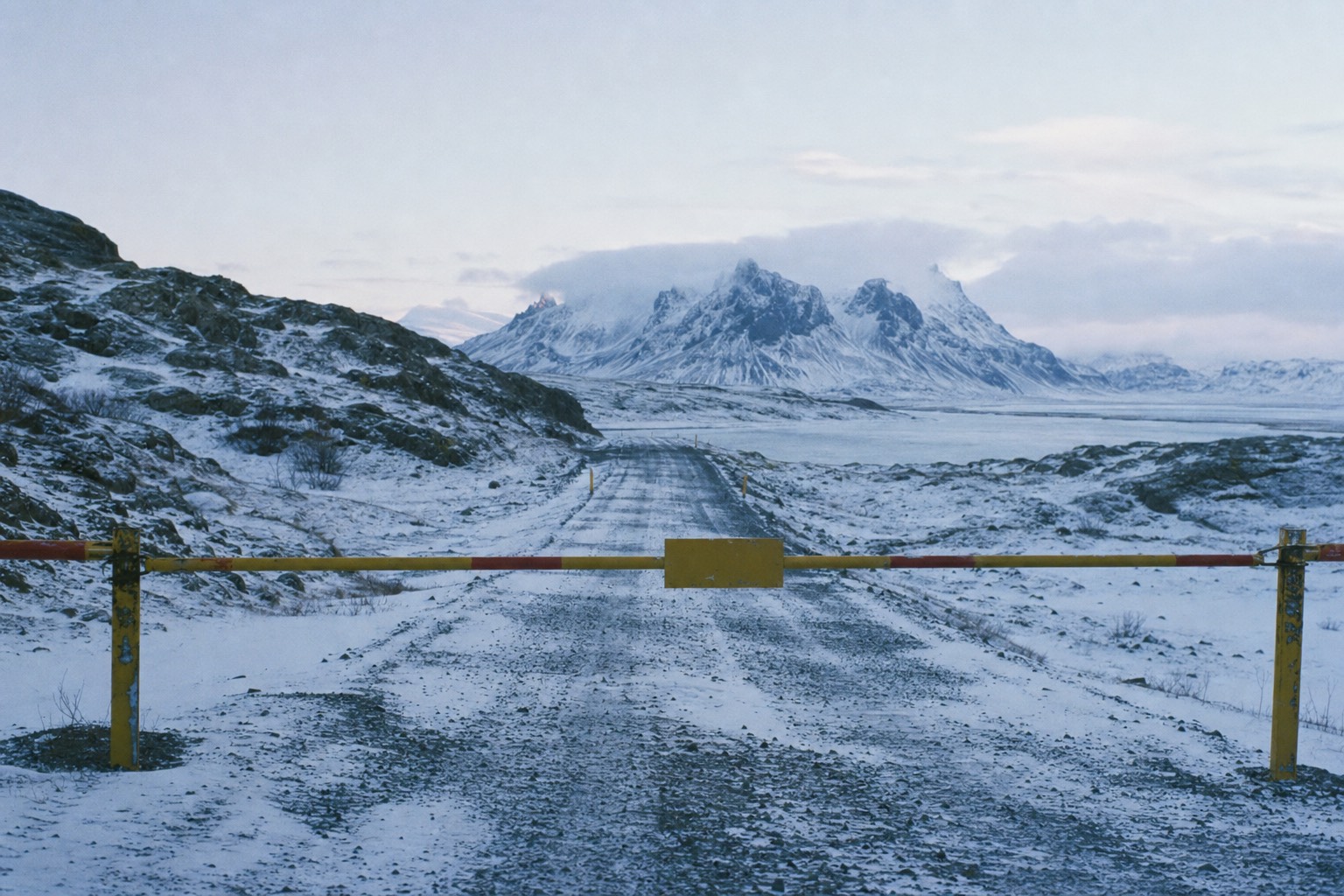
A woman once asked me, in a car park at Seljalandsfoss with sleet going sideways off the cliff, how long it would take to drive to Landmannalaugar. She had a photo of it saved on her phone from a "secret Iceland" list. It was the second week of January. The honest answer was that the road she needed had been under snow since October and would stay that way until June, and no vehicle she could legally hire would change that.
TL;DR: most hidden-gems lists for Iceland are written from summer photos and copied from each other. In winter the filter is not beauty, it is access. Highland F-roads are closed for the entire winter, which removes a large share of the famous secrets outright. What remains genuinely quiet and genuinely open is the stuff either side of the main tourist corridor, plus the glacier country that needs a guide rather than a hire car. Check road.is the morning you drive, every time.
Why do hidden gems lists stop working in January?
Because nearly all of them were written in July. In winter the question is not which spot is underrated, it is which spot you can physically reach before dark. Highland F-roads are closed all winter, mountain passes shut with little notice, and about four to five hours of usable daylight in January turns a two-hour detour into most of your day.
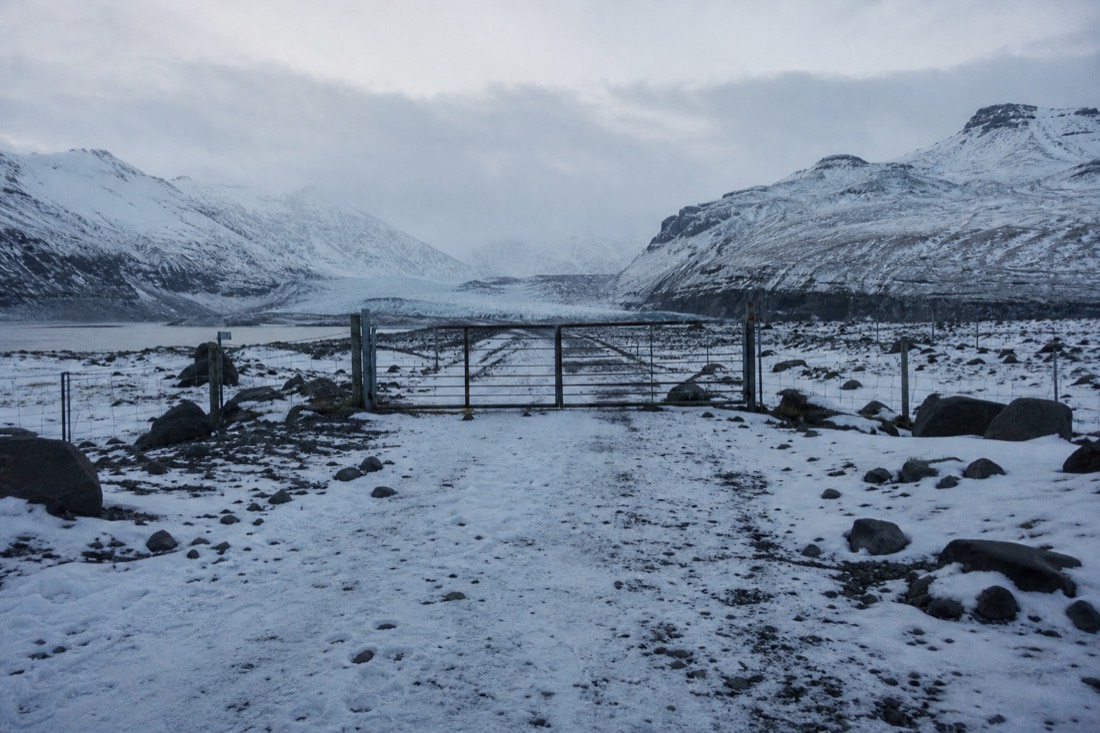
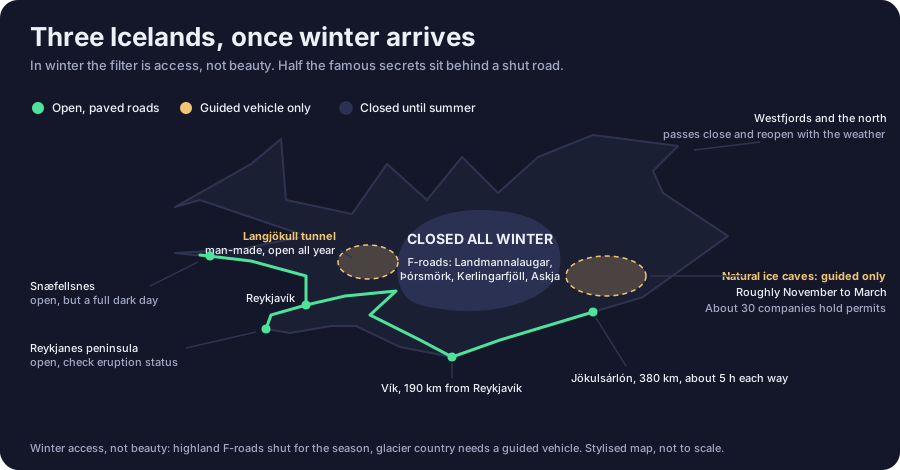
The recycling is easy to spot once you know the tell. A list names ten places, and six of them sit at the end of an F-road. F-roads are the mountain tracks marked with an F on the map, they are unpaved, they cross rivers, and they are closed for the whole winter season. Not "risky in winter". Closed. Hiring a big 4x4 does not open them, and the rental contract will say so.
The second tell is that the list never mentions light. In January Reykjavík gets about five and a half hours of daylight, and in December it is down to about four at the solstice. A place that photographs beautifully at 11am in July is a black shape in a headlight beam at 3pm in January.
| The famous "secret" | How you actually reach it | Winter status |
|---|---|---|
| Landmannalaugar | F208 / F225 mountain tracks | Closed. No exceptions, no vehicle solves it |
| Þórsmörk | F249, with river crossings | The road in is closed to normal traffic; only specialist operators run it |
| Kerlingarfjöll, Hveravellir, Askja | Highland F-roads | Closed for the season |
| Natural blue ice caves | Guided glacier vehicle only | Open, roughly November to March |
| Into the Glacier tunnel, Langjökull | Guided vehicle from the base | Open all year, because it is man-made |
| Snæfellsnes peninsula | Paved roads, long drive | Open, weather permitting, but it is a full dark-hours day |
| Reykjanes peninsula | Paved roads, close to Keflavík | Open, with volcanic status to check |
That last row matters more than people expect. There have been nine eruptions on the Reykjanes peninsula since December 2023, and none of them closed Keflavík airport, but individual roads and sites on the peninsula do get closed at short notice. The official Reykjanes eruption page is the place to look, not a travel blog from two winters ago.
What does winter actually close, and what stays open?
Everything behind an F-road is gone until summer. Mountain passes in the Westfjords and the north close and reopen through the winter with the weather. The south and west stay open most days. Natural ice caves are the opposite case: they only exist in winter, because they refreeze each cold season.
There is a neat irony in the ice caves. Every summer listicle calls them a hidden gem, and they are the one thing on the island you genuinely cannot do in July. They are carved by meltwater and reform each cold season, which is why the specific caves change from year to year, and why nobody can promise you the exact cave in the photo. Around thirty companies hold permits to run ice cave tours in Iceland, which tells you both that it is a real industry and that quality varies. I go into how to pick between them in which ice cave tour is best in Iceland.
The other genuine winter-only thing is scale of emptiness. Places that are miserable with coaches in August have twenty people in them on a Tuesday in February, and half of those twenty leave when the wind gets up. That is the real gem, and it is not a location, it is a timing decision.
| Month | Daylight in Reykjavík | What I would attempt in a day |
|---|---|---|
| November | About 6.5 h | South Coast to Vík and back, or Snæfellsnes if the forecast is calm |
| December | About 4 h | Golden Circle, or one South Coast stop cluster. Nothing further |
| January | About 5.5 h | South Coast to Vík, Reykjanes, Golden Circle. Not Jökulsárlón as a day trip |
| February | About 8.5 h | Jökulsárlón becomes possible as a very long day, Snæfellsnes comfortably |
| March | About 11.5 h | Almost anything on paved roads, including the north if the passes hold |
Reykjavík to Vík is about 190 km. Reykjavík to Jökulsárlón is about 380 km, roughly five hours each way, and in January both of those legs are driven in the dark. That is the sentence that decides most itineraries, and it is why the daylight hours guide exists.
Where do you actually find quiet in winter?
One road back from the famous stop, or two hours off the coach timetable. The South Coast corridor between Seljalandsfoss and Vík has quiet corners all winter, because the crowd moves as a block between four car parks and leaves everything in between empty. Timing beats location.
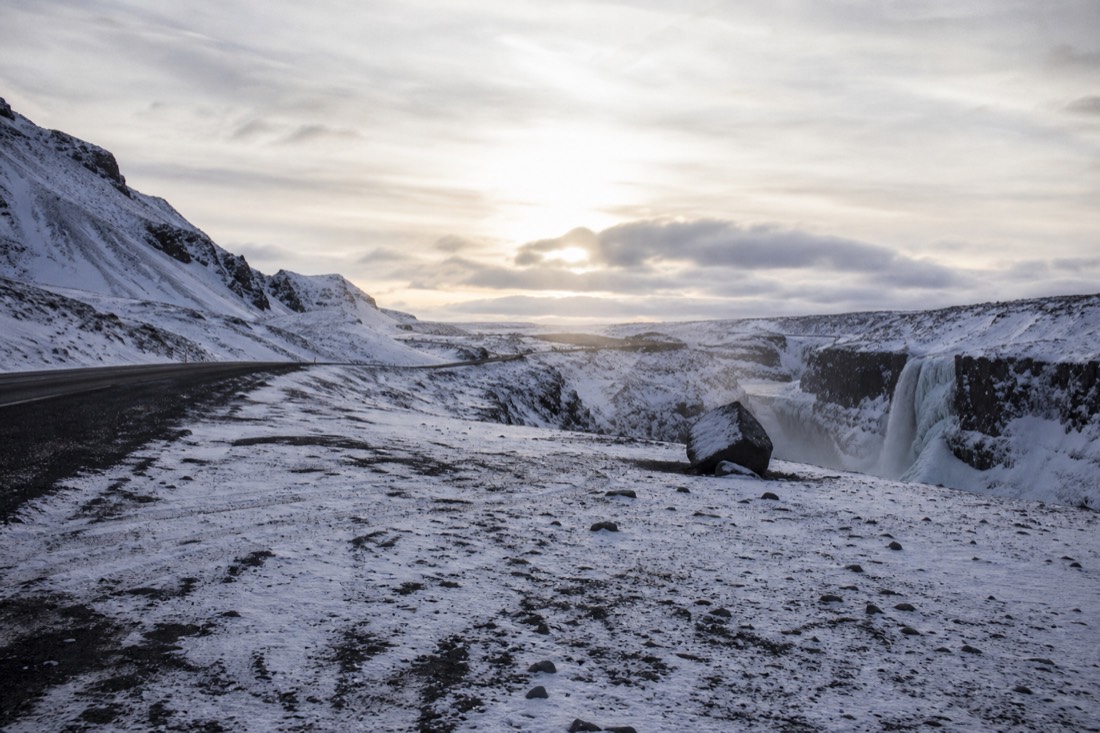
Coaches run to a schedule, and the schedule is legible. The big Reykjavík departures leave between eight and nine, which puts them at the first waterfall mid-morning and at the black sand beach in the early afternoon. Be at a stop an hour off that rhythm and it is a different place. In February I have stood at a beach that had forty people on it at 13:00 and four at 15:30, with better light in the second case.
The second move is lateral. Every headline stop on the South Coast has a smaller thing within twenty minutes of it that nobody films, usually because it does not fit a coach car park. Those are the ones I point people at, and they are the reason a self-drive day can beat a bus day if the conditions are kind. The trade-offs there are laid out in self-drive versus guided tours in Iceland in winter.
| The busy stop | The quieter move | The catch |
|---|---|---|
| Main South Coast waterfalls | Arrive after 15:00 rather than before noon | You lose the light in December and January |
| Reynisfjara black sand beach | The clifftop viewpoint side, in daylight only | Sneaker waves. Never turn your back on the sea |
| Golden Circle in convoy | Run it in reverse order to the coaches | Icy car parks early, before they are gritted |
| Jökulsárlón as a day trip | Sleep one night out east instead | Costs a night, saves ten hours of dark driving |
| Blue Lagoon at peak slot | An off-peak or late slot | Book ahead. Status can change with Reykjanes activity |
What needs a super jeep or a guide rather than a hire car?
Anything on a glacier, anything on an F-road, and anything involving driving off a maintained surface. That covers ice caves, glacier hiking, snowmobiling and the highland edges. These are not gatekeeping rules invented by tour companies, they are the terms of your rental contract and the limits of a standard vehicle.
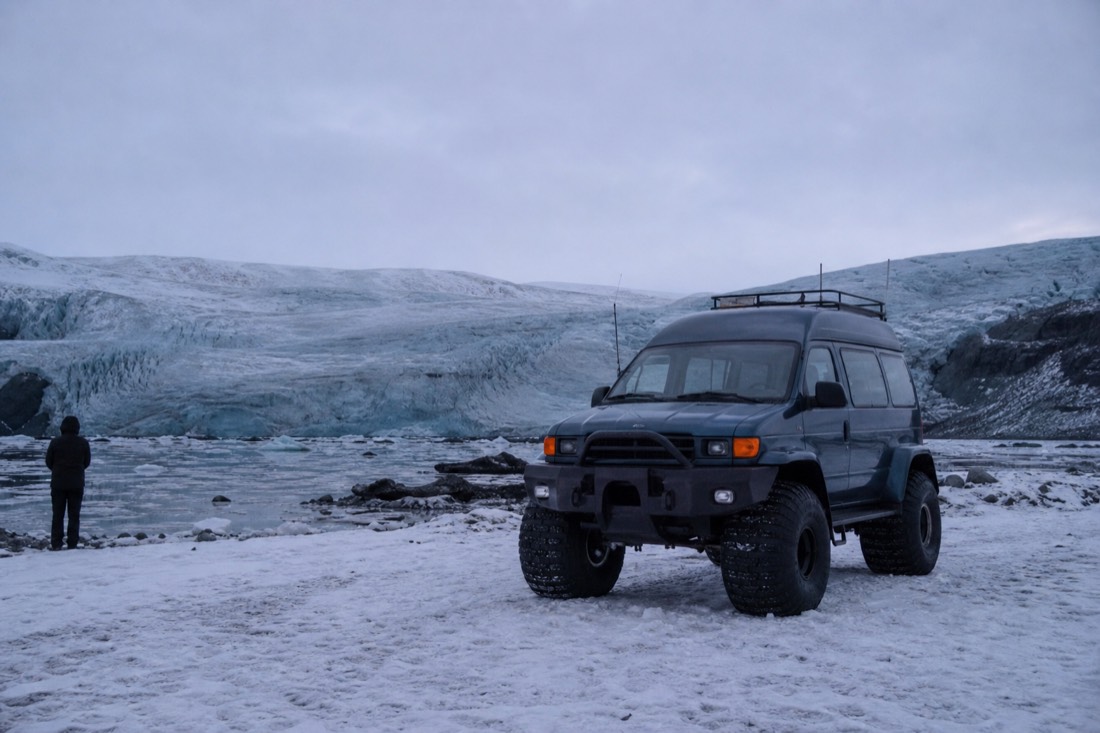
Glacier country is the clearest case. You do not drive yourself to an ice cave. The approach tracks are unmarked, the surface changes weekly, and the cave entrances move. Every operator running those trips uses a modified vehicle on tyres a hire car does not have, and the guides walking you in are reading crevasse conditions as they go. Read the reviews on any of the Vatnajökull ice cave tours and the pattern is the same: the ones people rate highly are the ones where the guide explained why the route changed.
Glacier hikes work the same way. Sólheimajökull is close to the road, which is what makes it the standard winter beginner hike, and it still needs crampons, an ice axe and someone who knows where the ice is thin this month. That kit comes with the tour.
If you want the practical version of all this in one long day, the South Coast run is the honest workhorse: it covers the waterfalls, the black sand and a glacier in one go, the whole South Coast tours category sits at 4.8 across 20,757 reviews, and the highest-volume departure is available to check for your dates on GetYourGuide.
Is it worth driving further to find somewhere quieter?
Usually not in December or January, and often yes in late February or March. Distance costs you daylight, and daylight is the scarcest thing you have. Past about three hours from Reykjavík, a day trip stops being a day trip and becomes a night drive with a landmark in the middle.
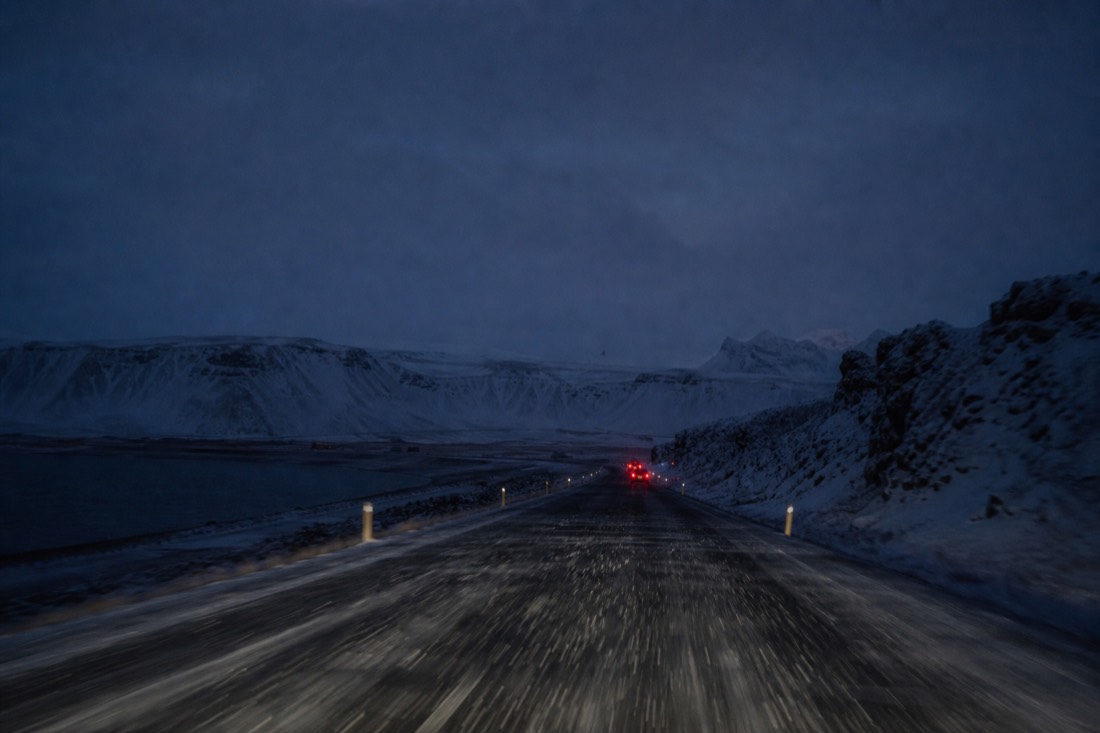
The clean example is Jökulsárlón. Five hours each way in January means you leave in the dark, arrive with the light already going and drive home in full darkness on a road that can drift shut behind you. People do it. I would not, and neither would most guides I know, unless the forecast is genuinely benign. The answer that actually works is to stop sleeping in Reykjavík: a two or three-day winter package puts you out east overnight, so the far end of the country becomes a morning instead of an expedition. The Troll Expeditions three-day version sits at 4.9 across 677 Viator reviews, and the whole category averages 4.8 across 1,146, which is the highest satisfaction of anything we track.
Snæfellsnes is the middle case. Paved the whole way, striking in snow, and a genuinely long day in winter light. In February it works. In late December you will see three things and a lot of headlights.
How do you check whether your gem is actually open today?
Two sites and one phone number. road.is shows live road conditions and closures across the country, updated through the day. safetravel.is carries the official safety picture, and 1777 is the road service line. If a road shows red on road.is at 08:00, that is your answer, not the weather app.
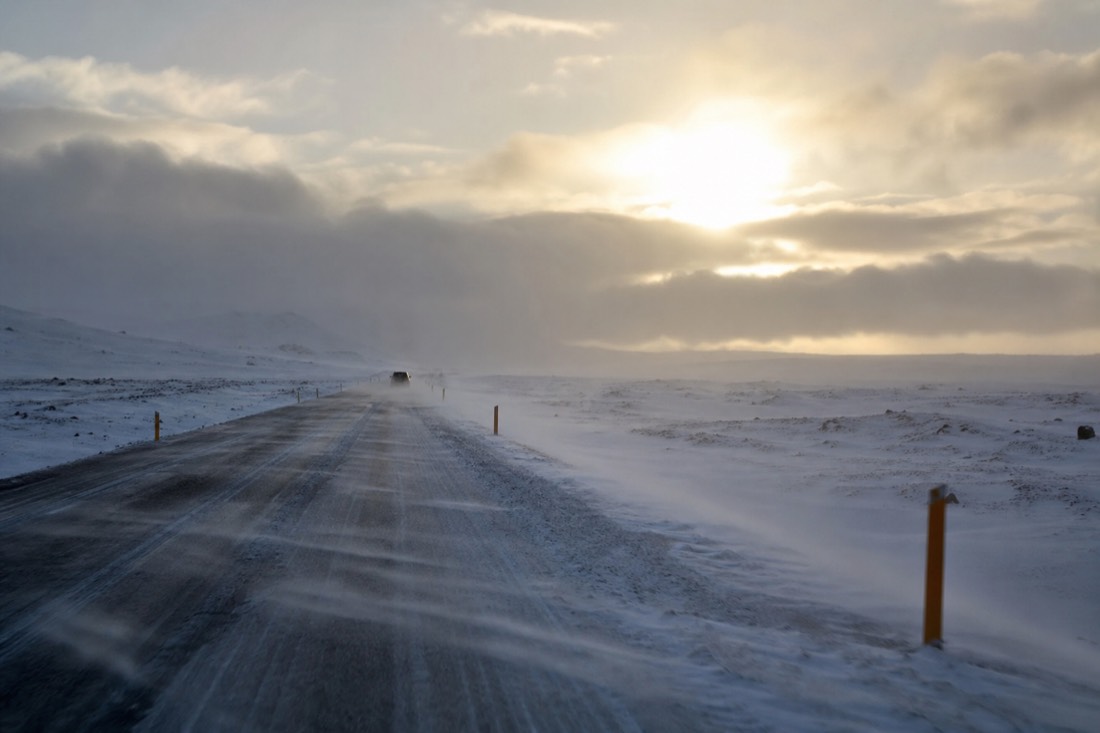
I check road conditions before every drive, and so does every working guide in this country. It takes thirty seconds. The pattern that catches visitors is a road that is open when they set out east and closed when they try to come back, because a wind warning arrived in between. Road.is shows both directions and updates through the day, and the official safety site is where you submit a travel plan if you are going somewhere thin on traffic.
The 112 Iceland app is the other thing to install before you leave home. It is free, it is official, and it puts your location in front of ICE-SAR if something goes wrong. If your plan for finding hidden gems involves a gravel track and no phone signal, that app is not optional.
Which hidden gems are hidden for a good reason in winter?
Some places are empty in January because nobody has told you about them. Others are empty because they are unlit, unfenced, unploughed or unsupervised, and the photograph that sold you on the place was taken in July. Learning to tell those two apart is the most useful winter skill on this page.
There is a version of the secret-spot list that is genuinely dangerous, and it is not the one naming closed roads. Closed roads announce themselves with a gate. The risky entries are the ones that are technically open: a canyon rim with no barrier, a coastal path that is fine in walking boots in August and is a sheet of ice in February, a lava field where the route is only obvious when you can see the ground.
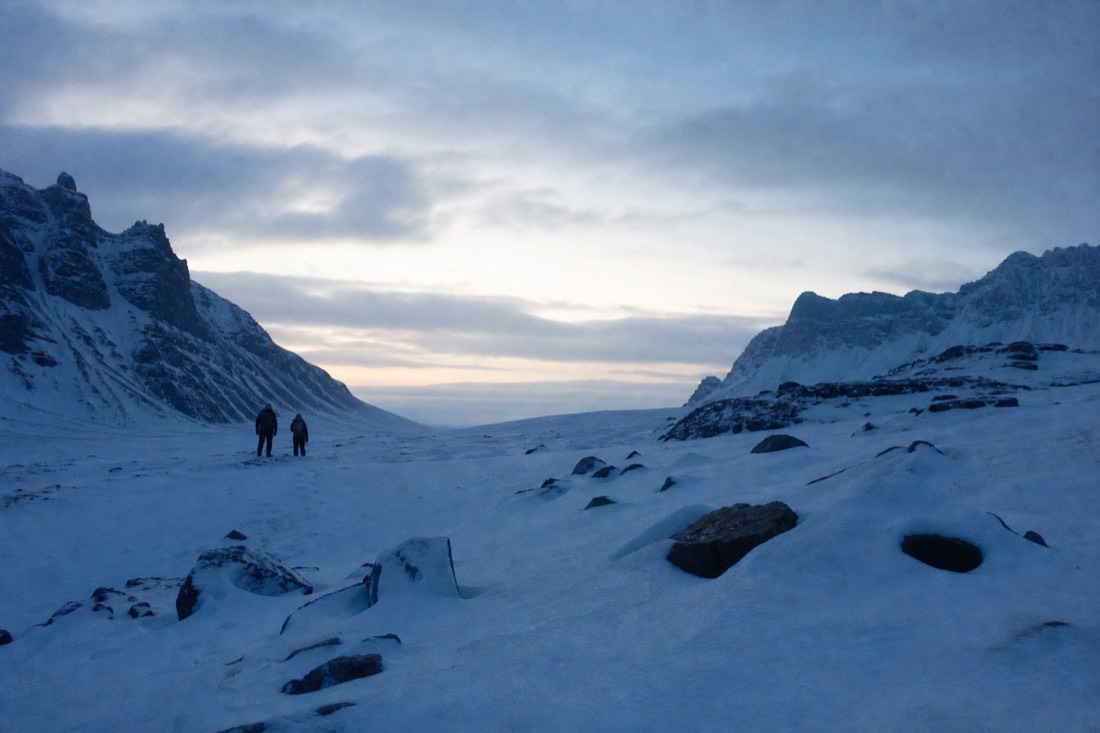
Snow is the part people underestimate. It does not just make a surface slippery, it fills things in and flattens the picture. Holes in a lava field disappear. The edge of a drop and the ground beyond it become one continuous white shape in flat light. In summer you can see where not to stand. In a January whiteout with the light going at three, you cannot, and there is nobody in the car park behind you either.
The other honest category is the place that is fine to reach and pointless once you get there. Half the famous viewpoints in this country are a view, and a view in the dark is a car park. That is not a safety issue, it is a waste of the four or five hours you were given.
| The kind of place | Why it is on every list | Why winter says no |
|---|---|---|
| A canyon rim with no fence | The view straight down | Ice on the lip, wind at your back, nothing to stop you |
| An unmarked coastal cliff path | Empty, dramatic, free | The ground you cannot see is the ground that gives way |
| A wild hot pot up a gravel track | It makes the best photograph on the internet | The track is the problem, not the pool |
| Anything at the end of an F-road | It is genuinely spectacular | Closed for the season, and a bigger 4x4 changes nothing |
| A lava field with no marked route | Nobody is ever there | Snow fills the holes and hides the edges |
| A long beach walk with no shelter | Wind, drama, black sand | You are a long way from a warm vehicle when it turns |
| A viewpoint you would reach after 16:00 | It is on the way home | You will be photographing a car park |
None of this is a reason to stay on the coach. It is a reason to pick winter targets on the basis of access and light rather than on the basis of somebody's summer camera roll. What the guided version of glacier country looks like, and why it exists at all, is in inside a Vatnajökull crystal ice cave, and the official conditions picture is on safetravel.is.
What does the quiet clock look like on a winter day?
Coaches leave Reykjavík between eight and nine, reach the first waterfall cluster mid-morning and the black sand in the early afternoon, then turn for home before the light goes. Anything an hour off that rhythm is a different place. The catch is that in December and January the quietest hour is also the darkest one.
You can watch this happen from a car park. The convoy is not a conspiracy, it is arithmetic: everybody is working with the same four or five hours of light and the same driving times, so everybody arrives at roughly the same moment. That predictability is what you can use.
Two moves come out of it. The first is to run the day backwards, which works better on the Golden Circle than on the South Coast because the loop lets you start at the far end. The second is to shift by an hour and accept a slightly worse light for a much better experience, which in February is an easy trade and in December is not a trade at all, because there is no hour to spare.
I have stood on the same beach at 13:00 with forty people on it and at 15:30 with four, and the second visit was the better one on every measure except brightness. That is the whole technique. It is not a location, it is a decision about when you leave the hotel.
| Roughly when | Where the coaches are | Where the quiet is |
|---|---|---|
| 08:00 to 09:00 | Still working through the Reykjavík pickup loop | Everywhere. Nothing has left town yet |
| 10:00 to 11:30 | The first waterfall cluster, at full strength | Further east, or a smaller stop nobody parks at |
| 11:30 to 13:00 | Moving between stops, or eating in Vík | The waterfall they have just left |
| 13:00 to 14:30 | The black sand beach, the peak of the day | The clifftop side, or anywhere off the main car park |
| 14:30 to 15:30 | Last stop, light going, everyone hurrying | The beach itself, with better light and fewer people |
| After 16:00 | Driving home in the dark | Everywhere, and you will see none of it |
If you are on a coach rather than in a car, none of this is yours to control, and that is a fair trade for not driving. The South Coast tours run the standard rhythm because the standard rhythm is what fits the light, and the honest comparison of the two approaches is in self-drive versus guided tours in Iceland in winter.
Is a secret hot spring a realistic winter plan?
Usually not, and the obstacle is the approach rather than the water. Wild pools sit at the end of gravel tracks and unlit paths, you change outdoors at around 0.5°C, and nobody is watching if something goes wrong. Every Icelandic town has a geothermal pool that solves all three problems for the price of a coffee.
This is the request I get more than any other, and I understand it completely. The image is irresistible: steam, snow, nobody else, a rock pool at the end of nowhere. What the image leaves out is the last kilometre of unploughed track, the ten metres of frozen mud between your clothes and the water, and the walk back to the car in wet hair with the temperature dropping.
There is also a courtesy problem that visitors rarely hear about. Land in rural Iceland belongs to somebody, these pools were never built for volume, and several natural sites have started charging for parking that used to be free, which tells you how the pressure is being felt. Turning up in February with a hire car and a screenshot is not quite the neutral act it feels like.
The local answer is the neighbourhood pool, and I am not offering it as a consolation prize. It is outdoors, it is hot, it is open on the worst weather day of your trip, and it is where Icelanders actually are in the evening. If you want the dramatic version with a transfer attached, the two big lagoons do that job without asking you to drive anywhere in the dark.
| The option | What winter access looks like | Honest verdict |
|---|---|---|
| A wild hot pot up a gravel track | Track condition decides it. Check road.is that morning | For confident winter drivers with daylight in hand |
| A wild pool on a short marked path | Sometimes straightforward, sometimes ice | Go with somebody, go early, tell someone where you are |
| A town swimming pool | Open, heated, cheap and everywhere | The local answer, and the one I actually recommend |
| Sky Lagoon | A short transfer from the city | Works on a day when everything else is cancelled |
| Blue Lagoon | Pre-booked, with occasional precautionary closures from Reykjanes activity | Check the status on the morning you go |
| A hotel hot tub | Already open, already there | Badly underrated at ten at night with snow falling |
Volcanic status is the one live variable in that table. There have been nine eruptions on the Reykjanes system since December 2023, the Blue Lagoon has continued operating with occasional precautionary closures, and the operator publishes its own seismic activity page. Both lagoons with transfers included are compared on the Blue Lagoon and Sky Lagoon page.
What does Björn actually point people at in January?
Three things, and none of them is a secret location. A second visit to a famous stop at a different hour. The stretch of road between two named places rather than the places themselves. And the pool in whatever town you are sleeping in, at nine at night, when the tour buses have all gone home.
I have spent my winters guiding on the South Coast and in glacier country since 2022, and the honest thing to admit is that my own list of good moments contains almost no places you could search for. It contains weather. A gap in the cloud over Eyjafjöll on the drive back. Spindrift coming off a ridge in low sun. A stop that was ordinary in the morning and extraordinary at half past three because the light had dropped four degrees.
So when somebody asks me for a hidden gem in January, what I usually give them is a timing and a direction rather than a pin. Go back to the waterfall you saw at eleven and stand there at three. Take the road that runs one valley inland instead of the coastal one, if it is open. Stop at the pull-in with no sign, the one between the two famous stops, where a farm track crosses a river and nobody has ever parked before you.
The second thing I tell people is less romantic. In the darkest weeks, quiet is not the scarce resource. Light is. If you spend your four usable hours driving towards emptiness, you have spent the only thing you cannot get more of. February brings more visitors than January, 147,000 through Keflavík against 119,000, and it is still the easier month for finding an empty stop, because 8.5 hours of light leaves far more of the day outside the two hours when the car parks fill. That is why I steer people who care about quiet towards the best month to visit Iceland in winter rather than towards a map pin.
The last one is not a place either. Sleep somewhere other than Reykjavík for one night. The whole character of the country changes when you are already out there at eight in the morning instead of two hours behind the day, which is what a multi-day winter package buys you, and it is the closest thing to a genuine hidden gem I can offer honestly.
What would I actually do with three quiet winter days?
One long South Coast day, one Golden Circle or Reykjanes day depending on volcanic status, and one day held loose for weather. That last one is not wasted, it is the reason the first two work, because it lets you move a cancelled tour instead of losing it.
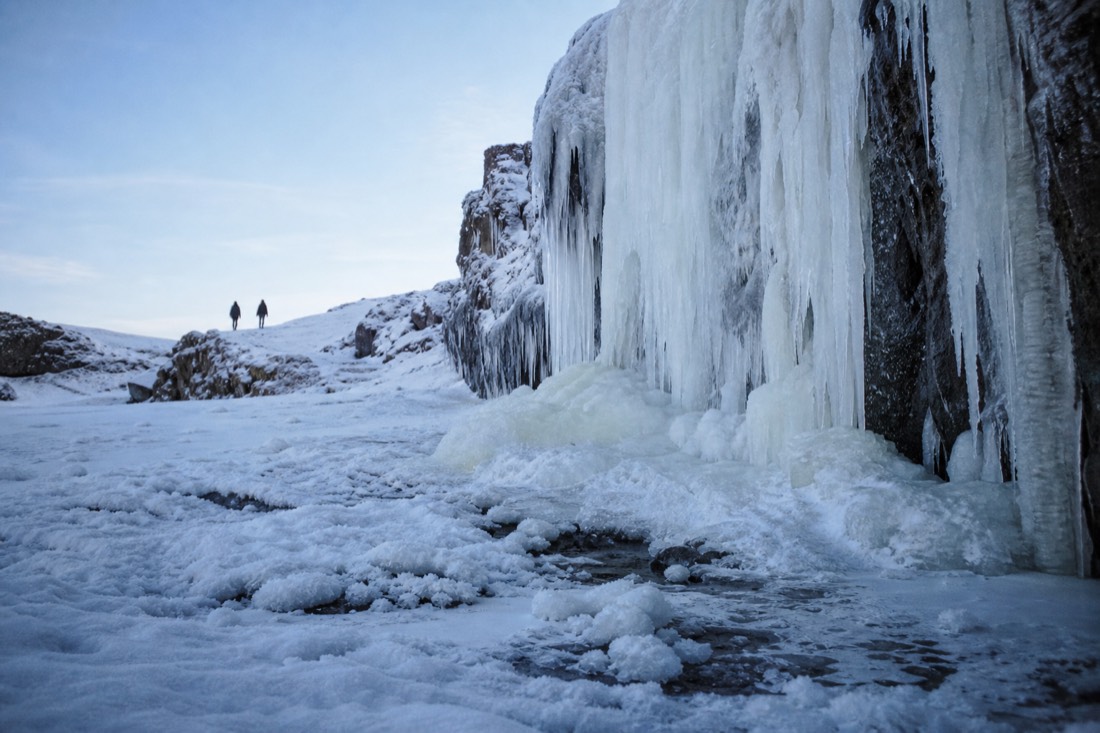
The floating day is the part nobody plans and everybody needs. Iceland cancels things in winter, and a trip with no slack turns one bad forecast into a ruined week. Operators reschedule or refund their own weather cancellations, and every listing on this site allows free cancellation up to 24 hours before departure, with one exception noted on the FAQ, so the flexibility is there if you build a day to use it.
As for the gems themselves, my honest view after a few winters of this: the memorable moments almost never come from the place on the list. They come from a stop nobody planned, made because the light did something on the way back. That is the argument in black sand beaches in a snowstorm, and it is the same lesson most first-timers write down afterwards in what I wish I knew before my first Iceland winter.
Go in February if quiet matters more than convenience. Accept that a third of the island is behind a locked gate until June. Then spend the time you saved on the parts that are open, at the hours the coaches are not there.
3-Day Ice Cave, South Coast, Golden Circle and Northern Lights
Build the quiet trip the way the article ends: one long day, one close day, one held loose. Book the long eastern days as a package before you fly, and let its 24-hour free cancellation plus the spare day absorb whatever the weather decides.
72h · en · Hotel pickup offered; details on the listing
Scheduled departure dates. Availability and final price are confirmed on Viator.
None of these experiences matches that choice. Adjust your preference or reset to the general recommendation.
Compare Options And Plan Your Trip
- Sleep east, skip the commute
- The package that makes the far country a morning.
- The winter-only gem
- The ash-banded cave, guided vehicle, no hire car reaches it.
- Off the convoy's clock
- A 19-seat minibus runs off the big-coach rhythm.
- The dramatic soak, transfer included
- Sky Lagoon's ritual, no dark drive to make.
- The machine day
- Langjökull by snowmobile, the guided-only landscape.
Before Booking
The Northern Lights are a natural phenomenon and cannot be guaranteed by the operator. The hotels are in prime locations to maximize chances of seeing them. Not included: Lunch and Dinner; Hiking Boots Rental (3,000 ISK); Waterproof Jacket Rental (1,750 ISK)