What to wear in Iceland in winter: the packing list
Reykjavik averages about 0.5°C in January and the wind does the damage, not the number. Here is the layering system, the jeans problem, and what operators already supply.
 Written with Björn Einarsson, Icelandic guide & winter tour specialist
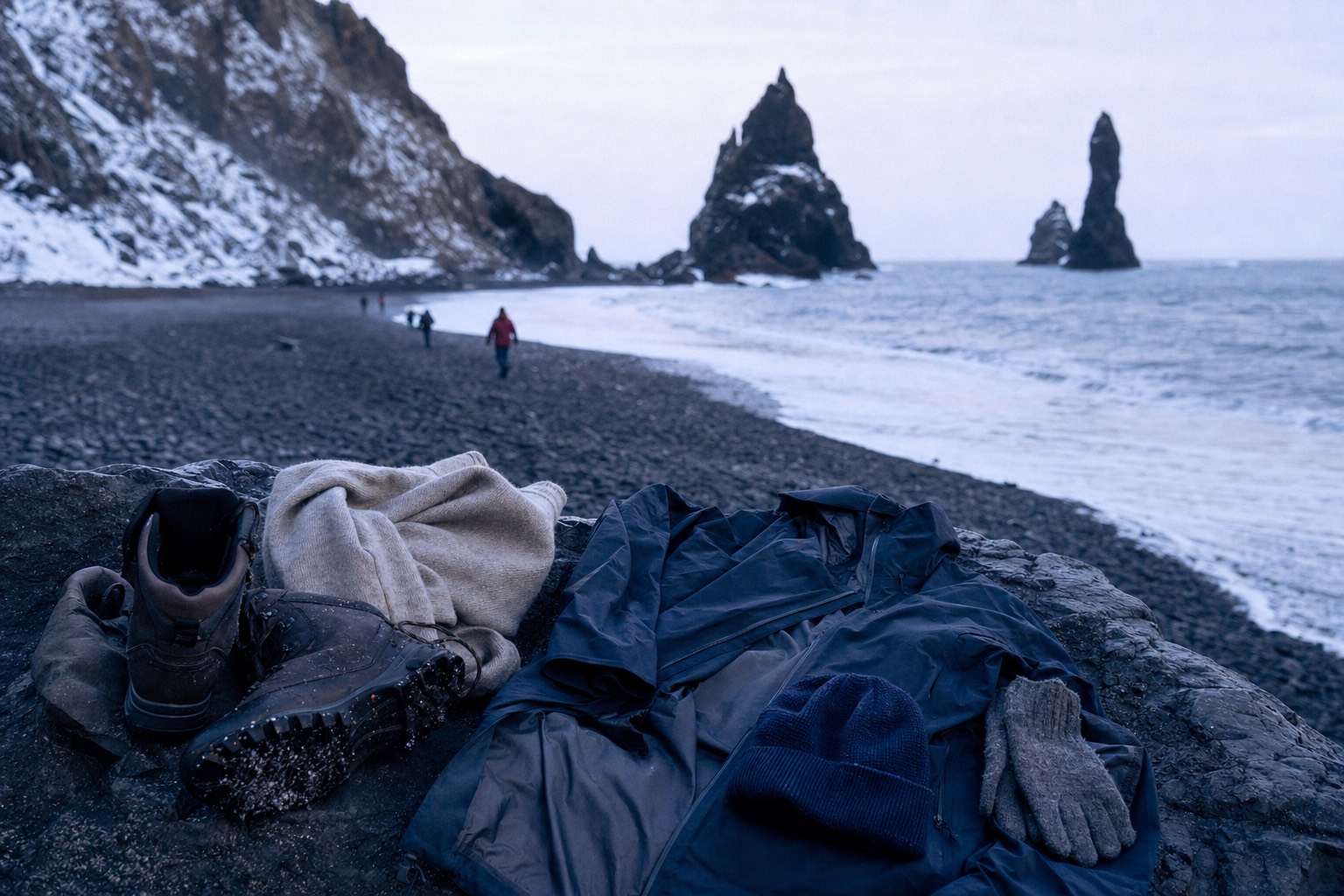
Sleet in Iceland does not fall so much as travel sideways, and the first place it finds is the gap between a glove and a sleeve. I have watched a visitor step off the coach at Skógafoss in a beautiful wool coat, last about four minutes in the spray, and spend the rest of the stop sitting in the bus with the heater on. The coat was not cheap. It was just the wrong material, worn over the wrong trousers, in the wrong wind.
TL;DR. Three layers, and the outer one has to stop wind and water. No cotton anywhere, and jeans least of all. Boots with deep tread, a hat that covers your ears, waterproof gloves plus a thin spare pair, and something over your face for the aurora stops. Leave the umbrella at home. Do not buy crampons, a helmet or a drysuit: the glacier, ice cave and Silfra operators issue those on the day, and the whale boats hand out thermal overalls at the gangway.
What should you actually wear in Iceland in winter?
Wear three layers: a wool or synthetic base against the skin, a fleece or light down mid-layer for warmth, and a windproof waterproof shell over both. Add waterproof trousers, boots with real tread, a hat, a neck gaiter and gloves. The shell matters more than the thickness of anything underneath it.
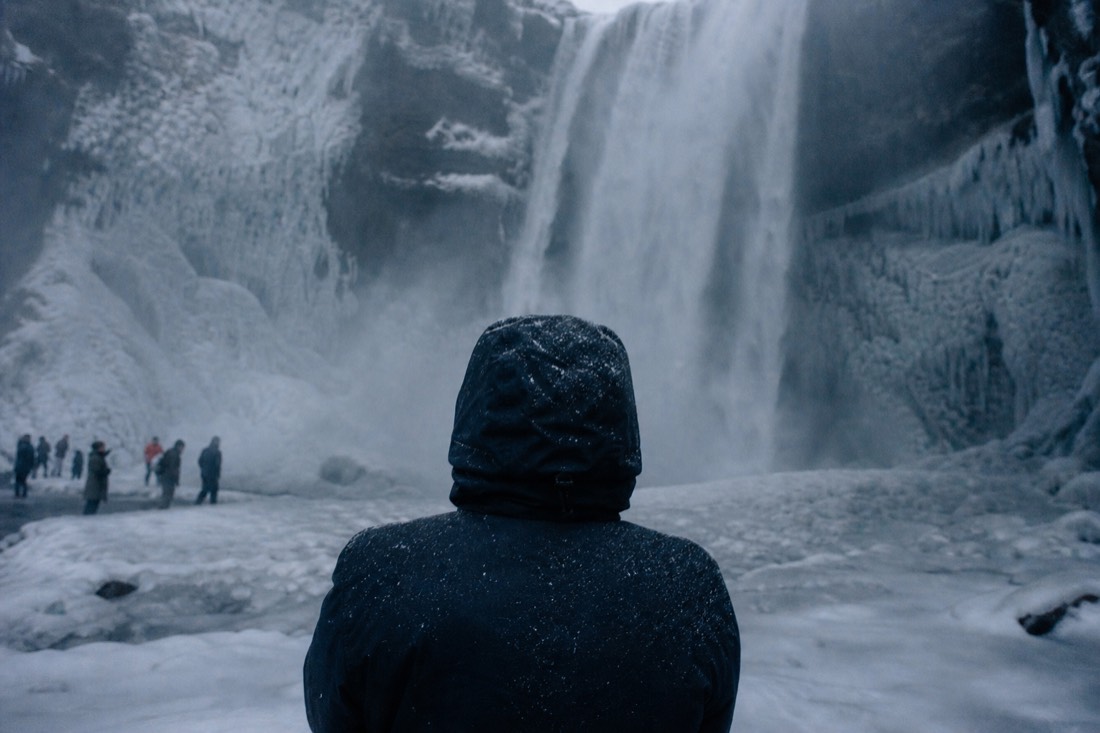
The number people plan around is the temperature, and it misleads them. Reykjavík sits at about 0.5°C on average in January, which sounds survivable, and on a still day it is. Then you stand on an exposed headland with a wind coming off the North Atlantic and that same 0.5°C strips heat off you faster than a dry minus ten inland would.
So the system is built against wind and water, not against cold air. The base layer's job is to move sweat away from your skin, because damp skin is cold skin. Merino wool does this well and does not start to smell after two days. Synthetic base layers work too and cost less.
The mid-layer traps warm air. A fleece, a thin down jacket, a wool jumper, any of them will do, and on a mild February day you may take it off between stops.
The shell is the layer that decides whether the trip is pleasant. It has to be genuinely waterproof rather than water-resistant, and it has to have a hood that stays up in wind. A hood that blows off is a hood you will hold with one hand for the entire waterfall stop.
Waterproof over-trousers are the piece most people skip and most people regret. They pack down to nothing, they go on over whatever you are already wearing, and they are the difference between enjoying Seljalandsfoss and enduring it. If you want a fuller picture of the conditions you are dressing for, the guide on what an Icelandic winter is actually like covers the weather side properly.
Why should you not wear jeans in Iceland?
Because denim is cotton, cotton soaks up water and holds it, and wet cotton pulls heat out of your legs instead of keeping it in. Jeans take hours to dry in a cold coach. On a northern lights stop you may stand still outdoors for an hour, and that is exactly when wet legs turn into a miserable night.
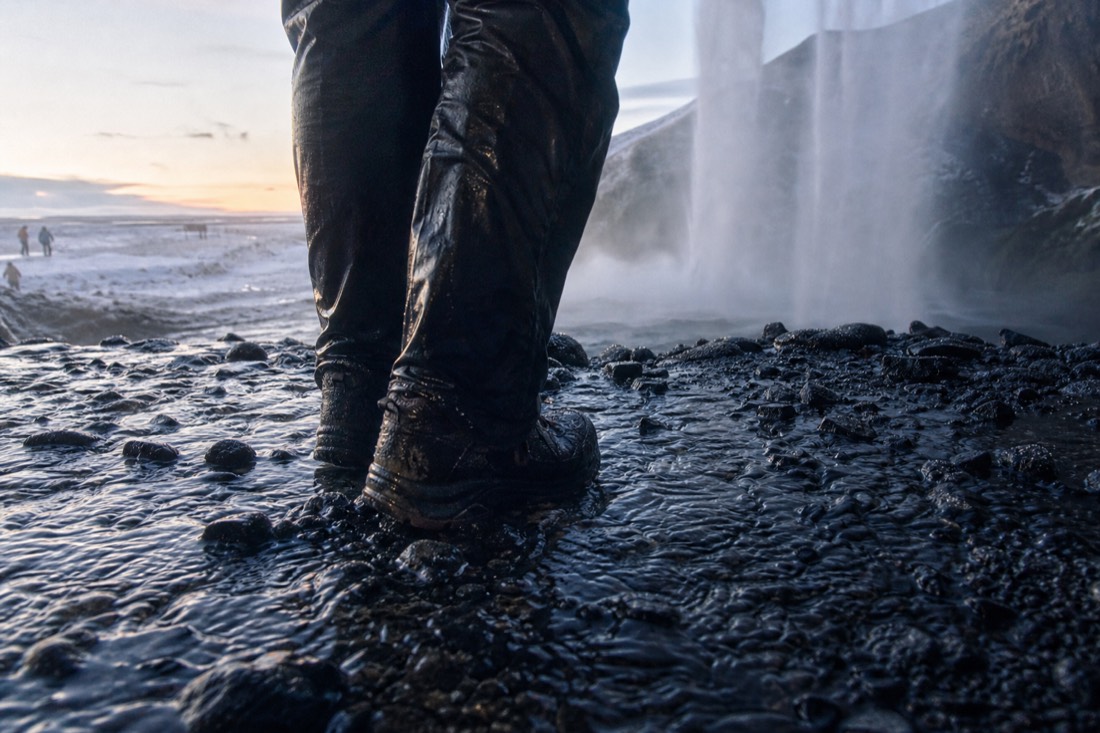
This is the single most common mistake I see, and it is worth explaining properly rather than just repeating the rule. Wool and synthetics keep some insulating value when damp, because their fibres still trap air. Cotton does not. Once denim is wet, the fibres collapse together, water fills the gaps, and water conducts heat away from your skin many times faster than air does. Your legs then heat the wet fabric instead of heating you.
Two Icelandic situations make this worse than it sounds. The first is waterfall spray. Seljalandsfoss throws mist a long way in the right wind, and Skógafoss will soak you at the base without any rain falling at all. The second is standing still. A northern lights stop is not a walk. You get off the coach in a dark car park or a farm track, you stand, you wait, and you keep waiting because the display might build. An hour of standing still in wet denim in a cold wind is genuinely unpleasant and, in the worst cases, a real safety issue.
The fix costs nothing complicated. Thermal leggings under fleece-lined trousers or hiking trousers, waterproof over-trousers on top when it is wet, and the jeans stay in the suitcase for the evening in Reykjavík. I have written more about why this rule became such an obsession among Icelandic guides in why nobody wears jeans in Iceland.
What kind of coat is best for an Icelandic winter?
A waterproof, windproof shell with a proper hood, worn over an insulating mid-layer. A big untreated down parka is warm but useless once wet, and a fashion wool coat is worse. If you own only one coat, make it a hardshell and add warmth underneath rather than buying a thicker single jacket.
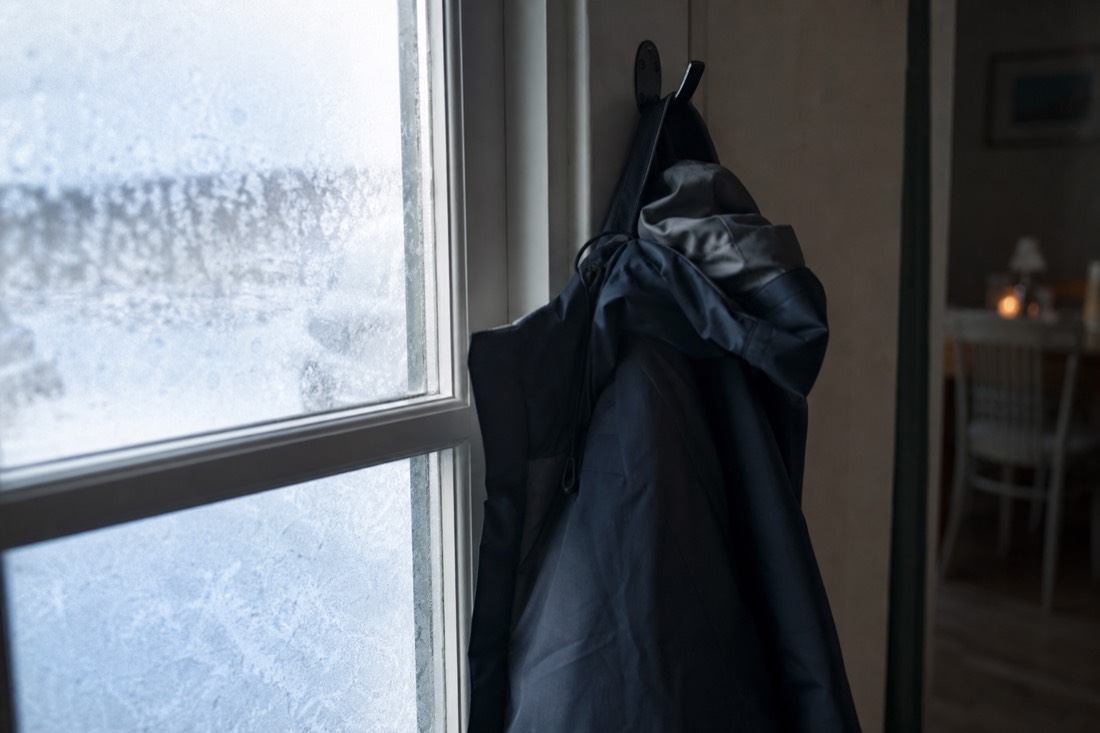
Coats are where the money goes and where the mistakes get expensive, so it helps to think about what each type actually does in Icelandic conditions rather than what it says on the label.
| Coat type | How it copes with Icelandic winter | Verdict |
|---|---|---|
| Hardshell (waterproof, windproof, uninsulated) | Stops the wind and the rain completely, no warmth of its own | The right choice, layered over fleece or down |
| Insulated waterproof parka | Shell and warmth in one, bulkier, harder to regulate on a warm coach | Excellent if you own one, run it with a thin base layer |
| Untreated down puffer | Very warm dry, loses most of its loft once soaked | Fine as a mid-layer under a shell, poor as an outer layer |
| Softshell | Blocks wind, sheds drizzle, gives up in real rain | Acceptable for Reykjavík, not for a South Coast waterfall stop |
| Wool overcoat | Looks the part, wets through, catches the wind | Evening wear in the city and nothing else |
| Ski jacket | Built for exactly this, waterproof and insulated | Bring the one you already own, no need to buy anything new |
Two details separate a good shell from a frustrating one. The hood needs a stiffened peak and a real adjustment, so it holds shape and stays put in wind. And the cuffs need to close, because the standard failure point is water running down a sleeve while you hold a camera up.
If you are working out whether to buy gear or borrow it, the honest arithmetic is in what an Iceland winter trip costs: a shell you will use again is worth buying, a one-week novelty is not.
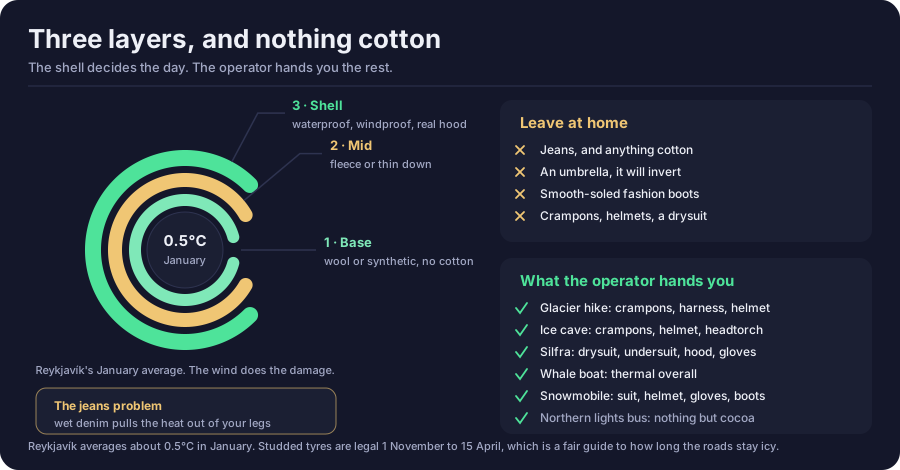
How should you layer for each type of winter tour?
The base and mid layers barely change. What changes is the outer layer and the extras: a whale boat needs wind protection above all, a glacier hike needs stiff boots and gaiters, an aurora night needs standing-still warmth, and a Blue Lagoon trip mostly needs flip-flops and a plan for wet hair.
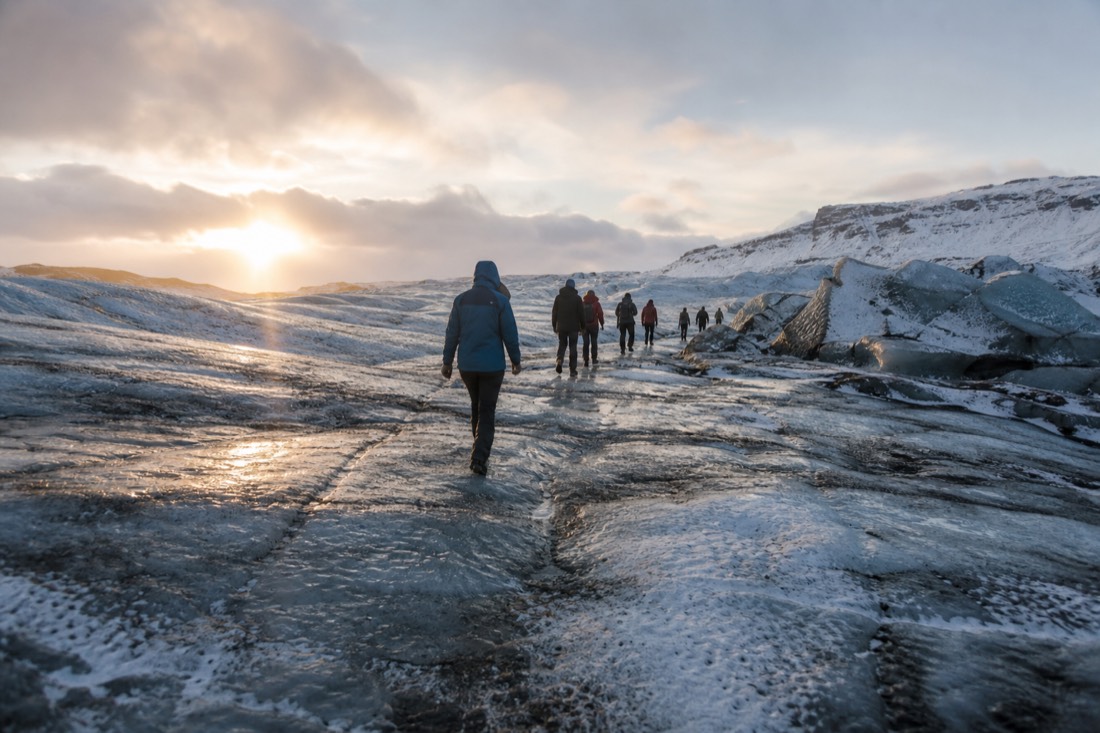
Different days ask different things of the same wardrobe, which is why a single packing list annoys people. Here is how the same three layers get deployed.
| Tour type | Base | Mid | Outer and extras |
|---|---|---|---|
| South Coast day tour | Wool base top and leggings | Fleece | Waterproof shell and over-trousers, boots with tread, hat, gloves |
| Northern lights hunt | Wool base, thickest you own | Down or heavy fleece | Shell, over-trousers, thick socks, face gaiter, hand warmers |
| Glacier hike | Wool base | Fleece | Shell, stiff-soled walking boots, gaiters if you have them, sunglasses |
| Ice cave trip | Wool base | Fleece | Shell, waterproof boots, gloves you can grip with, headtorch optional |
| Whale watching | Wool base | Fleece | Windproof shell under the boat's overalls, hat that will not blow off |
| Snowmobiling | Wool base | Fleece | Operator suit over everything, goggles or sunglasses, thin liner gloves |
| Silfra snorkel | Thin thermal base | Provided | Drysuit undersuit provided, bring warm dry clothes for afterwards |
| Golden Circle | Wool base | Fleece | Shell, boots with grip for the Gullfoss path in ice |
| Blue Lagoon | Whatever you are travelling in | Any | Swimsuit, flip-flops, hair conditioner, warm hat for the walk out |
Footwear deserves its own note, because it is the item people most often get wrong after the trousers. You want boots with deep, widely spaced tread and enough ankle support to walk a frozen car park confidently. Reykjavík pavements ice over, and the Gullfoss viewing steps in January are their own small adventure. Slip-on ice grips that stretch over a boot sole cost very little, weigh nothing and turn a nervous walk into an ordinary one. They are not the same as crampons, and you do not need crampons: those come with the glacier trip.
What do the tour operators already give you?
Quite a lot, and packing duplicates of it wastes suitcase space. Glacier operators supply crampons, a harness and a helmet. Ice cave tours add the helmet and headtorch. Silfra includes the drysuit, hood and gloves. Whale boats lend thermal overalls. Snowmobile operators provide the suit, gloves, helmet and boots.
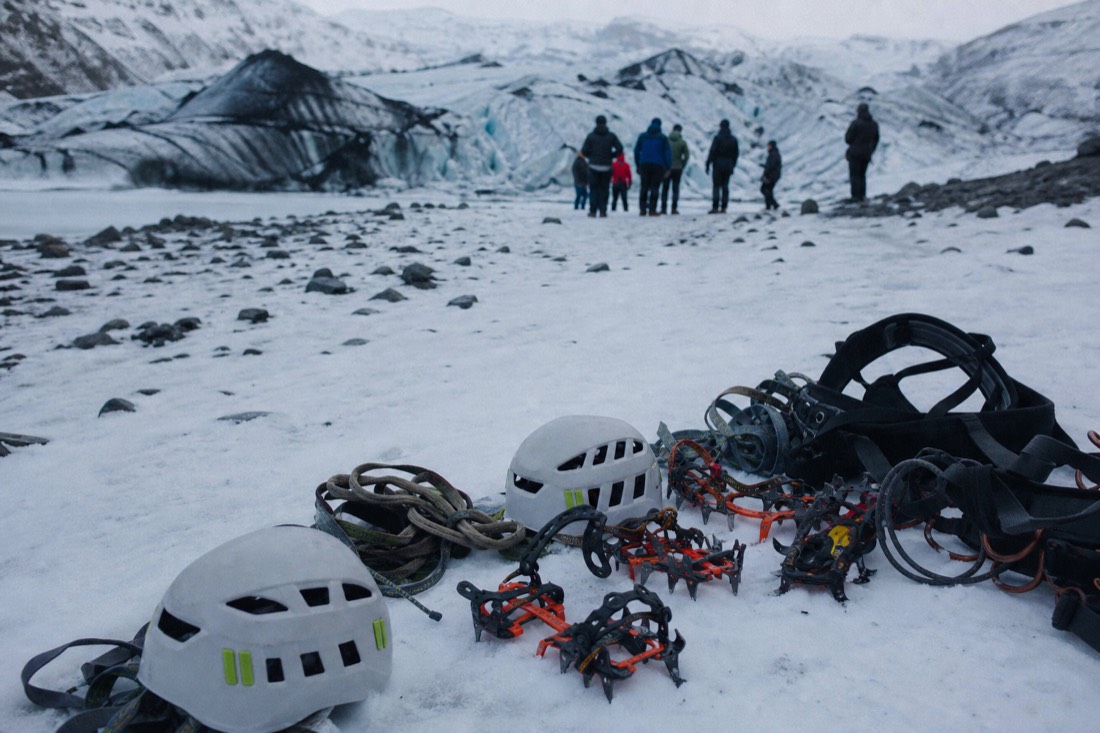
The rule of thumb: anything specialised and safety-related is issued at the meeting point, because the operator's own insurance depends on the fit and condition of it. Anything ordinary is yours to bring.
| Tour type | The operator supplies | You bring |
|---|---|---|
| Glacier hiking | Crampons, harness, ice axe, helmet | Stiff walking boots, layers, waterproofs, gloves |
| Ice cave | Crampons, helmet, headtorch | Waterproof boots, warm layers, gloves |
| Snowmobiling | Overall, helmet, balaclava, gloves, boots | Base layers, goggles or sunglasses, thin liner gloves |
| Silfra snorkelling | Drysuit, undersuit, hood, neoprene gloves, mask | Thermal base layer, warm dry clothes and a towel for after |
| Whale watching | Thermal overall on board | Windproof outer layer, hat, gloves, seasickness tablets |
| Northern lights bus | Nothing but the coach and the hot drink | Everything, this is the coldest standing you will do |
| South Coast and Golden Circle | Coach and guide only | Full three layers, boots, ice grips |
That last row is the one to read twice. A northern lights coach gives you a warm seat and a cup of cocoa, and then it puts you outside in the dark at whatever spot has the clearest sky. The tour itself does nothing to keep you warm. If you want a sense of how those nights run before you dress for one, what a northern lights tour is actually like walks through a real one, and the northern lights tours page lays out which departures include a free retry night.
What should you leave at home?
Umbrellas, jeans, fashion boots with smooth soles, heavy hiking gear you will never use, and any specialised safety kit the operator issues anyway. Also skip the giant suitcase: most winter day tours pick up from a Reykjavík hotel or bus stop and you will be living out of one bag for a week.
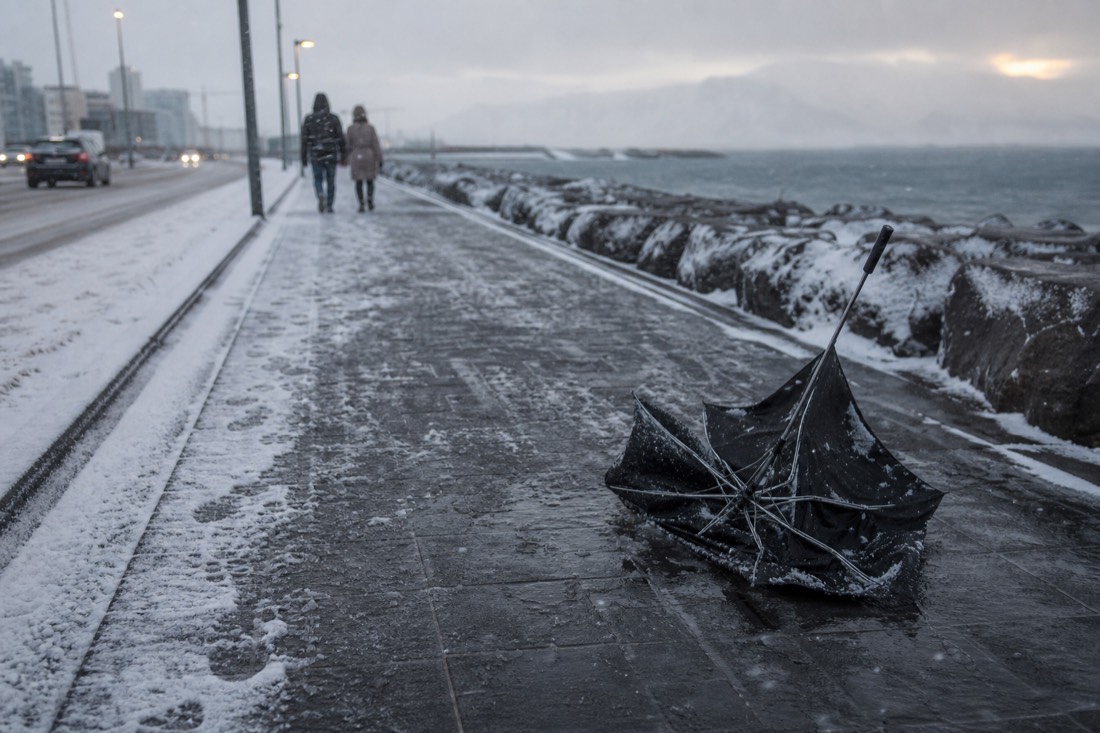
Umbrellas are the comic one. They invert on the first gust and then you carry a broken metal thing all day. A hood does the same job and cannot be destroyed by weather.
Smooth-soled boots, including most fashion and city boots, are the practical hazard. Icelandic towns grit the main routes but car parks and paths at the sights are frequently glazed, and a fall on ice ends trips. If your boots are stylish and slick, buy the stretch-on ice grips before you go rather than paying Reykjavík prices for them.
Then there is the over-packing category: crampons bought online, a climbing helmet, a full snow suit for a city break, a tripod you will use once. The gear the tours require comes with the tours. What genuinely does not come with them is a second pair of gloves, and I would put that near the top of any list. Gloves get wet, and a wet pair on a five-hour drive stays wet.
Two things worth checking rather than packing. Road conditions on the morning of any drive at road.is, which is what every Icelandic guide has open at breakfast, and the official safety channel safetravel.is, where you can leave a travel plan and pick up the 112 Iceland app. Neither weighs anything.
What boots do you actually need, and what about traction?
Waterproof boots with a deep, widely spaced lug pattern and enough ankle support to walk a glazed car park. Leather or synthetic both work if the membrane is real. Add stretch-on ice grips for towns and viewpoints. You do not need crampons: the glacier and ice cave operators issue those and will not let you use your own.
Footwear is where the packing list stops being about comfort and starts being about whether you fall over. Icelandic winter surfaces come in about four varieties and each one wants something slightly different from a sole. Wet snow over tarmac wants deep lugs. Polished ice on a pavement wants metal spikes, because rubber of any compound simply cannot grip it. Loose black sand at Reynisfjara wants a boot that seals at the ankle. Hard glacier ice wants crampons, which is why you are handed a pair.
The mistake that costs money is buying stiff mountaineering boots for a trip that is mostly coach steps and car parks. Unless you have booked ice climbing, you want a walking boot you can wear for ten hours without thinking about it. Stiffness only earns its keep on the ice, and even the glacier hiking tours mostly ask for a sturdy sole rather than a technical one. Check the listing, because a few glacier operators do state a minimum boot type and will hire you a pair if yours falls short.
Waterproofing is not optional and it is not the same as water resistance. Slush finds the seam above the sole, and once a boot is wet inside it stays wet for the rest of the trip, because a hotel radiator does not dry a boot overnight. Two pairs of socks and one pair of boots beats one pair of socks and two pairs of boots, every time.
| Footwear | Where it works in Iceland | Where it fails |
|---|---|---|
| Waterproof walking or hiking boot, deep tread | Everything: coaches, car parks, waterfalls, black sand, glacier transfers | Nothing much, this is the answer |
| Insulated winter snow boot | Standing still on aurora stops, long cold days out | Bulky and hot on a heated coach, poor ankle feel on ice |
| Stiff mountaineering boot | Ice climbing, long glacier days | Overkill and uncomfortable for a normal tour week |
| Trail runner or approach shoe | Reykjavík on a dry day | Wet feet within one waterfall stop, no ankle support |
| Fashion or city boot, smooth sole | The restaurant, and only the restaurant | Any ice at all, and Icelandic pavements ice constantly |
| Wellingtons | A very wet, very flat day | No insulation, no ankle support, cold feet fast |
Traction devices are the cheapest upgrade in this entire guide, and the important thing is knowing which type does what. Stretch-on grips with small spikes or coils turn a nervous walk to breakfast into an ordinary one and live in a coat pocket the rest of the day. They are not crampons, they do not belong on a glacier, and no operator will accept them as a substitute.
| Traction device | What it is for | What it will not do |
|---|---|---|
| Stretch-on ice grips with coils or studs | Town pavements, car parks, viewpoints, the Gullfoss steps | Hold you on hard glacier ice |
| Heel-only slip-on grips | Flat urban walking, easy to put on over a shoe | Grip on any slope or uneven ground |
| Operator-issued crampons | Hard glacier ice on a hike or a cave approach | Come with you: they are fitted and checked on the day |
| Walking pole | Balance on icy paths and loose black sand | Replace grip, and it is one more thing to carry |
How do you keep a camera and a phone working in Icelandic winter?
Cold flattens batteries, wind drives spray onto the front element, and moving from a freezing car park into a heated coach fogs everything you own. Keep spare batteries against your body, carry a real cloth rather than a sleeve, and put the camera in a bag before you get back on the bus, not after.
Almost everyone comes to Iceland to photograph something, and almost everyone loses at least one good shot to the same three problems. The first is battery. Lithium cells lose capacity in the cold, so a battery that lasts a full day at home can die halfway through a South Coast tour, and it will partly recover once warm. Two spares in an inside pocket solves it completely.
The second is water, and Icelandic water arrives sideways. Seljalandsfoss and Skógafoss throw mist far enough to coat a lens in seconds, and a wet front element ruins every frame in a way you will not notice until you get home. Microfibre cloth in a pocket, checked before each shot, is the whole technique. A wet sleeve just moves the water around.
The third is condensation, and it is the one that catches serious photographers rather than casual ones. Cold glass in warm humid air fogs on the inside as well as the outside, and the fix is temperature change managed slowly: seal the camera in a bag before you board the coach so the moisture condenses on the bag rather than the lens. Twenty minutes of patience saves an afternoon.
For the aurora specifically, the constraint is not gear so much as hands. You will be setting a long exposure in the dark, in wind, with a headtorch, and bare fingers stop working within a couple of minutes. Set the camera up before you leave the hotel, work in liner gloves, and use a strap. Details of how those evenings actually run are in what a northern lights tour is actually like, and inside an ice cave the problem inverts: light levels are much lower than your eyes suggest, which is covered in which ice cave tour is best.
| The problem | What actually happens | What to do about it |
|---|---|---|
| Cold batteries | Capacity drops fast, the camera reports empty while it still has charge | Spares in an inside pocket, rotate them, they revive when warm |
| Waterfall spray on the lens | Every frame soft and flared, and you cannot see it on a small screen | Microfibre cloth in a pocket, wipe before each shot, hood on |
| Condensation on the way indoors | Fogging inside and out, sometimes for an hour | Bag the camera before boarding, unpack it once it has warmed |
| Wind at aurora stops | Long exposures blurred, tripods walking across gravel | Weight the tripod, brace on the vehicle, shorten the exposure |
| Gloves off in the dark | Fingers useless in a couple of minutes, then a dropped camera | Liner gloves, settings dialled in before you leave, use the strap |
| Black sand blown into the body | Grit in the zoom ring and the mount, which is permanent | Change lenses inside the coach, never on the beach |
| Salt spray on a whale boat | Corrosion on metal and coatings if it dries on | Rinse and dry the body at the hotel that evening |
Pack it, buy it in Reykjavík, or leave it at home?
Pack the layers you already own, buy only the small things you forgot, and leave anything the operator issues. Outdoor kit in Reykjavík is easy to find and not cheap, so the shopping list you want on arrival is short: ice grips, a hat, maybe over-trousers, and nothing that costs as much as the tour you came for.
Kit gets bought in a panic on the first morning, which is the most expensive way to do it. The audit below is the version I would run a week before a flight, sitting on the bedroom floor with everything laid out. Most people discover they already own three quarters of it and are missing two cheap things.
There is one structural point about layering that no item list captures. Systems do not fail at the coldest point, they fail at the gaps: the wrist between glove and sleeve, the neck above the zip, the small of the back when you bend over a camera, and the ankle above the boot. Sleet finds all four. Close them with a gaiter, longer cuffs and a top layer that reaches past your waistband, and the same clothes suddenly perform two grades better.
The other quiet failure is sweat. A heated coach at Icelandic settings is warm, and if you keep everything on between stops you arrive at the waterfall already damp underneath. Strip the mid-layer on the bus and put it back on before you step out. Guides do this every single stop, and visitors almost never notice.
| Item | Pack, buy here, or skip | The reasoning |
|---|---|---|
| Waterproof windproof shell | Pack | The one piece worth owning properly, and the trip is unpleasant without it |
| Fleece or light down mid-layer | Pack | Anything warm works, no need for it to be technical |
| Merino or synthetic base set | Pack | Two sets is enough for a week, wool does not need daily washing |
| Waterproof over-trousers | Pack, or buy here if you forgot | Cheap, packable, and the most skipped item on the list |
| Waterproof boots, deep tread | Pack | Broken in already, which matters more than the brand |
| Stretch-on ice grips | Buy here if you must, but cheaper at home | The best value item in Icelandic winter, weight almost nothing |
| Waterproof outer gloves plus liners | Pack both | Liners let you work a camera without going bare-handed |
| Buff or neck gaiter | Pack | Closes the neck gap and covers your face on aurora stops |
| Swimsuit and quick-dry towel | Pack | Lagoons and public pools both need one, and hotel towels are not yours to take |
| Dry bag or a few plastic bags | Pack | Wet gloves, wet swimsuit and a camera should not share a rucksack |
| Sunglasses | Pack | Low winter sun sits at eye level, and glare off snow and ice is severe |
| Small daypack | Pack | Everything you take off on a warm coach has to live somewhere |
| Spare camera and phone batteries | Pack | Cold halves what you thought you had |
| Crampons, helmet, harness, drysuit | Skip | Issued at the meeting point, and your own will not be accepted |
| Hairdryer, travel kettle, umbrella | Skip | Hotels have the first two, and the third does not survive Iceland |
Where you are going decides how hard any of this gets tested. A Reykjavík week with lagoon afternoons asks very little of your wardrobe, while a February day that runs from a waterfall to a black beach to a glacier edge asks everything at once, which is the case made in what an Icelandic winter is actually like and in black sand beaches in a snowstorm. If you have not fixed your dates yet, the best month to visit Iceland in winter guide will tell you how much of this you will really need.
What small items make the biggest difference on a tour day?
A spare pair of gloves, a face gaiter, hand warmers, thick wool socks, a headtorch, a power bank and a refillable water bottle. None of them are expensive and each one solves a problem that otherwise sits with you for eight hours in a coach.
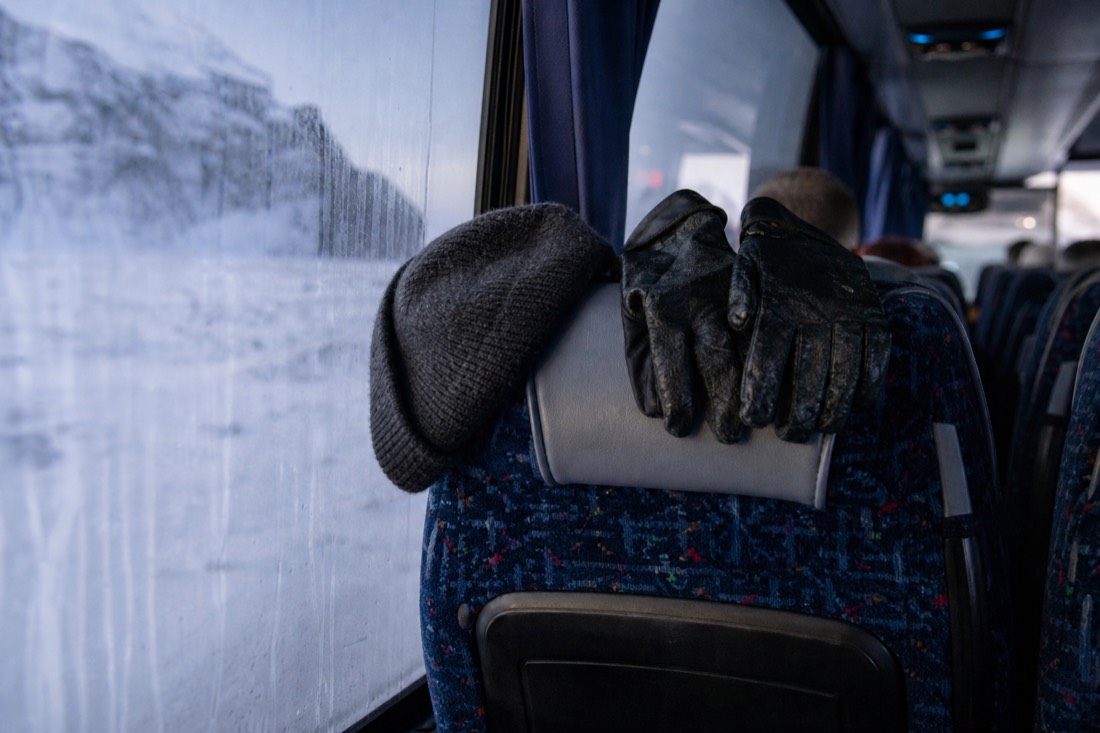
Cold hands ruin more winter days than cold feet. You take gloves off to work a camera, they get wet, and there is nowhere on a coach to dry them. Carry a thin liner pair inside the waterproof outer pair and you can shoot photographs without going bare-handed.
A neck gaiter you can pull up over your nose is the cheapest comfort upgrade in Iceland. On an aurora stop the wind is doing the work, and covering the face changes the experience completely.
Battery life is the other quiet problem. Cold flattens phone batteries fast, and your phone is your camera, your map and your pickup confirmation. Keep it in an inside pocket against your body and carry a power bank.
Wool socks, two thicknesses, and a proper water bottle. Icelandic tap water is excellent and free, so buying bottled here is money set on fire.
If you are pointing all this at one trip in particular, the South Coast is the day that tests every layer you own: waterfall spray, black sand wind at Reynisfjara, and a glacier edge in the same outing. The South Coast tours page compares the real departures, and the most-reviewed of them, BusTravel Iceland's 10 to 12 hour run at 4.8 across 12,306 GetYourGuide reviews, is available to check for your dates on GetYourGuide.
For everything else people ask before they book, our FAQ answers the pickup, cancellation and weather questions in one place. And if you are still deciding whether to hire a car and dress for your own driving instead, self-drive versus guided tours in winter is the honest comparison, because a driver needs different gear again: a scraper, a spare pair of dry gloves in the boot, and the patience to turn back.
From Reykjavík: South Coast Waterfalls, Glacier and Black Beach Day Tour
Have your travel dates in mind? Check the South Coast day before you finalize anything else on this list: it is the booking your packing is really built around, and it cancels free up to 24 hours before it runs.
10 to 12 hours · English
Check travel dates with GetYourGuide below.
None of these experiences matches that choice. Adjust your preference or reset to the general recommendation.
Compare Options And Plan Your Trip
- Waterfalls, black sand and a glacier edge
- The full three-layer test in one 10 to 12 hour day from Reykjavík.
- A standing-still aurora night
- The coldest standing hour of your trip; the listing includes hot cocoa and a free retry night.
- Glacier hiking or an ice cave
- Crampons, harness and helmet are issued on the day; you bring the boots and the layers.
- A lagoon afternoon, not a hike
- Swimsuit and towel are the only kit you need; the transfer from Reykjavík is part of the booking.
Before Booking