Is the Golden Circle Worth It in Winter? A Verdict
Yes, with one caveat. The Golden Circle is the 6.5-hour day you book when the forecast is bad, and the four bookable tours compared on their real ratings.
 Written with Björn Einarsson, Icelandic guide & winter tour specialist
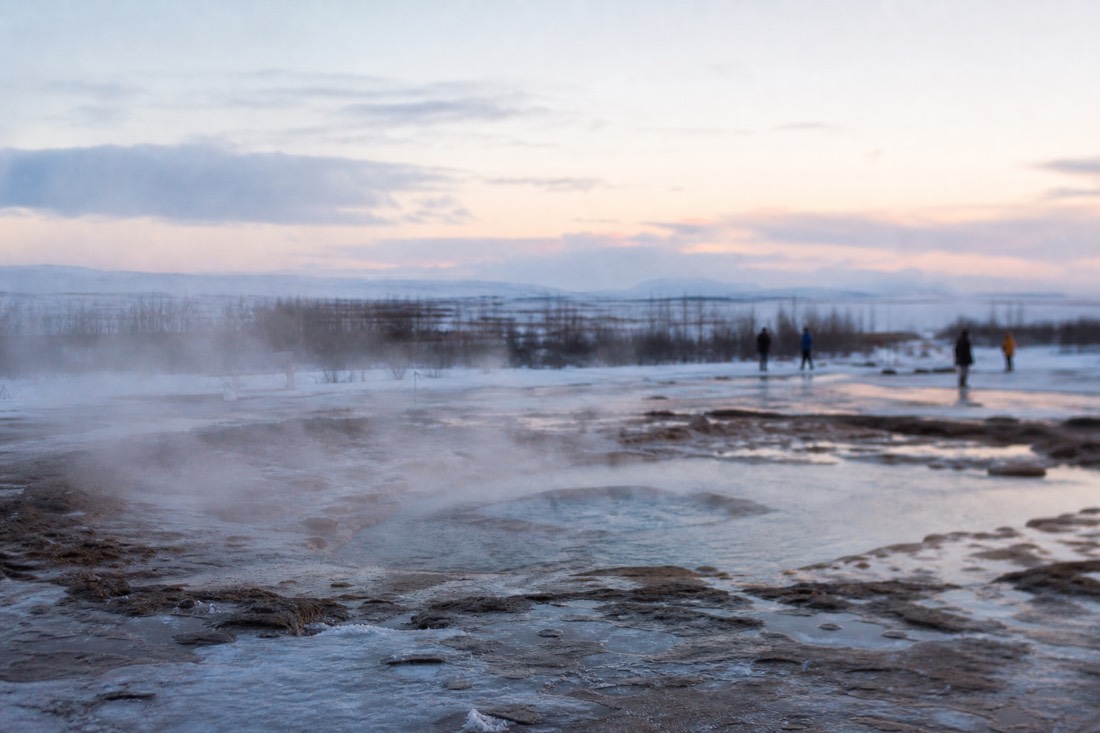
Strokkur goes off every few minutes whatever the season, but in winter you notice the sound before the water: a low gulp as the pool drains, then the bang, and then the steam does something it never does in July. It hangs. In still air below freezing the whole column just sits there over the crowd for several seconds before drifting off, and forty people who came to photograph a jet of water end up photographing a cloud instead. That is the Golden Circle in winter in one image. Same route, same stops, completely different behaviour.
TL;DR. Yes, the Golden Circle is worth it in winter, and it is the single most reliable day on an Icelandic winter itinerary. It is short at around 6.5 hours, it stays close to Reykjavík, and its roads are among the first the country clears, which means it runs on days when the long drives east are cancelled. The caveat is honest: the lower viewing platforms at Gullfoss are roped off when they ice over, and the paths at Þingvellir get genuinely slippery. Neither ruins the day. Both are worth knowing before you stand there in trainers.
Is the Golden Circle worth it in winter?
Yes, and for a specific reason: it is the day you book when the forecast is bad. The loop is short, it sits close to Reykjavík, its roads are gritted and cleared early because they carry daily traffic, and the sights themselves are improved rather than diminished by ice. It is the most cancellation-proof day in Icelandic tourism.
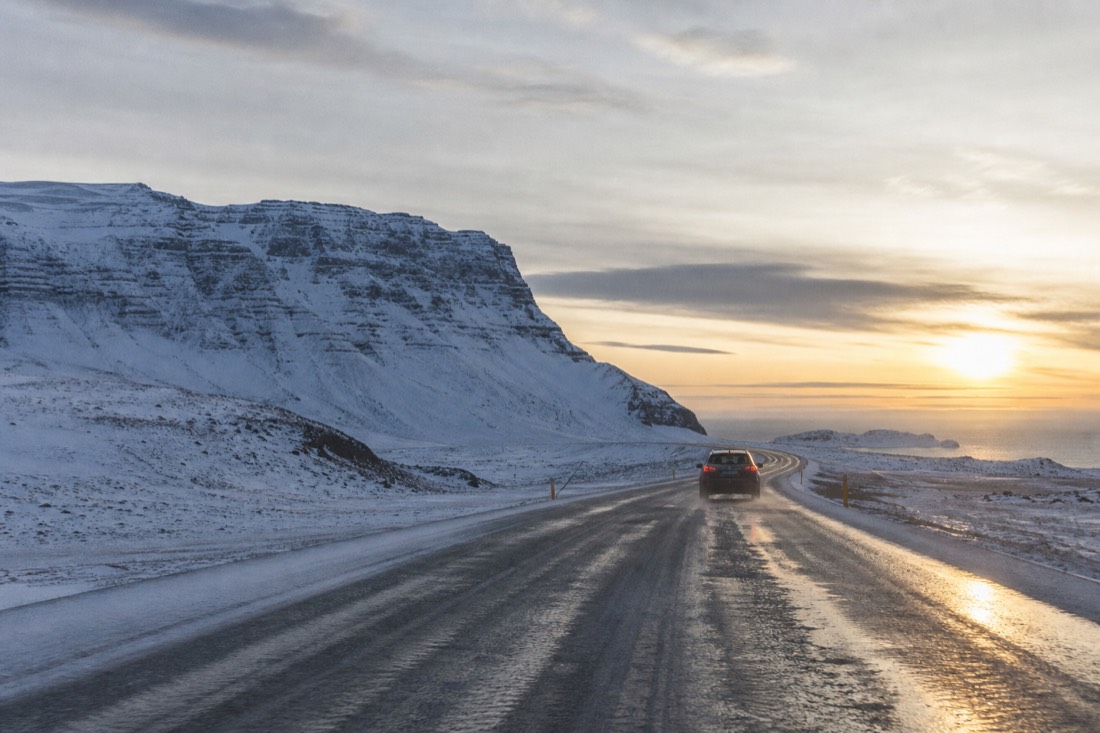
Every winter I watch the same thing happen. A deep low comes through, the South Coast road east of the river turns orange on the map, the glacier lagoon departures come off the board, and the Golden Circle coaches leave Reykjavík as normal. That is not luck. The loop runs through the inhabited southwest on roads that people commute along, so they get cleared first and stay open longest, and no leg of it takes you far enough from the city to be stranded.
The second reason is that winter genuinely suits these three sites. Gullfoss with ice built up along the canyon walls is a more serious object than Gullfoss in July. Steam behaves better in cold air. Þingvellir under snow reads more clearly as a rift valley, because the shape of the ground is not hidden under vegetation. You are trading crowd levels and comfort for atmosphere, and on this particular route the trade is good.
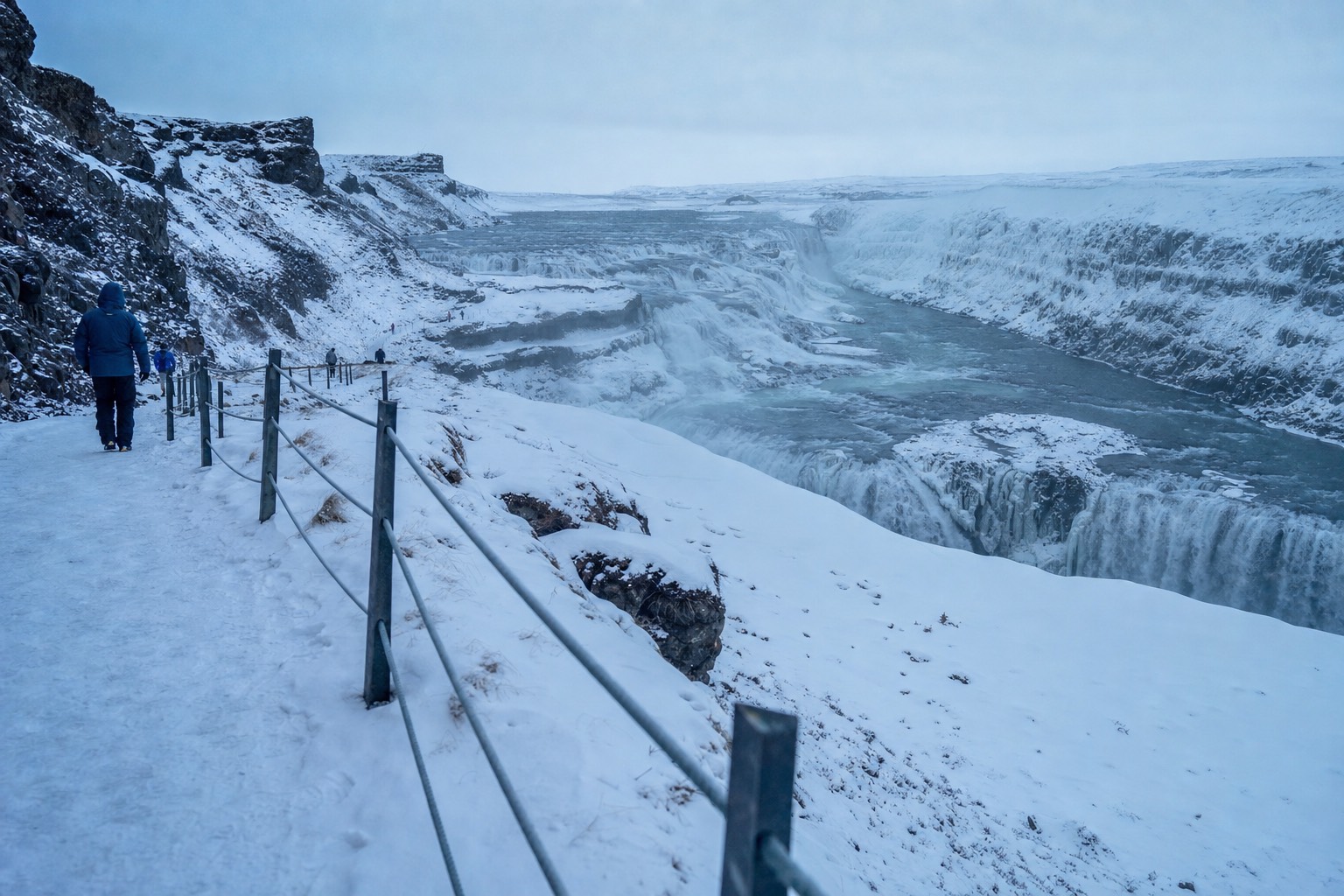
The honest counterweight is access. When the spray freezes onto the paths, the lower platform at Gullfoss gets closed, and you see the falls from the upper viewpoint instead of standing beside them. Þingvellir's walkway down through the rift becomes a polished slide in places. Nobody hides this, but nobody puts it in the tour description either.
If the wider question is whether to hand the driving over at all in a winter month, that argument is worked through in self-drive versus guided tours in an Icelandic winter.
What changes at Þingvellir, Geysir and Gullfoss once the ice arrives?
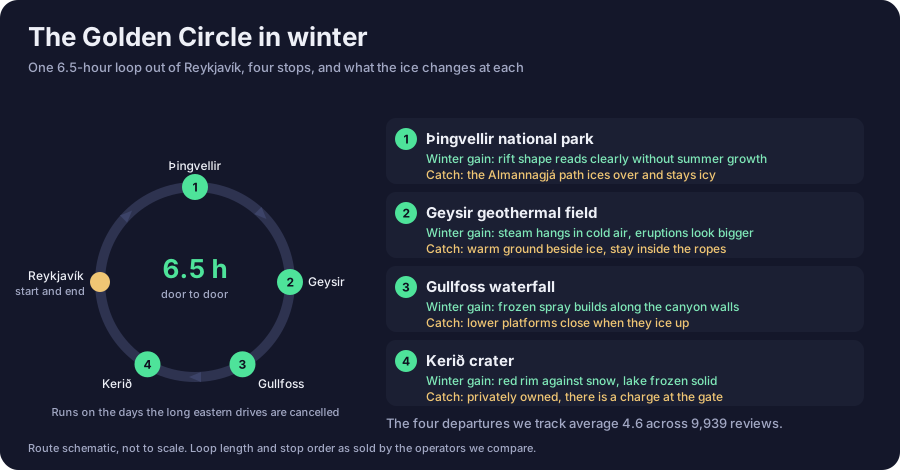
Each stop changes in a different direction. Þingvellir gets more legible and more slippery. Geysir performs better because cold air holds the steam. Gullfoss becomes far more dramatic and partly less accessible, since the platforms nearest the water are the first thing to be closed when spray freezes onto them.
At Þingvellir the winter improvement is structural. Strip out the summer green and the rift between the North American and Eurasian plates stops being a pleasant gorge and starts looking like what it is: two continents pulling apart, with a lake sitting in the gap. The path down through Almannagjá is paved and handrailed, and it also faces away from the sun for most of the winter, so meltwater refreezes on it overnight. This is the single most likely place on the loop to fall over.
Geysir is the stop that needs the least explanation and gets the most photographs. Strokkur is the one that actually erupts on a short cycle, the original Geysir being largely dormant, and the entire field is a working geothermal area, meaning the ground is warm, the snow melts in patches and there are ropes for good reasons. In winter the contrast is theatrical: bare hot ground, steam, and snow lying two metres away.
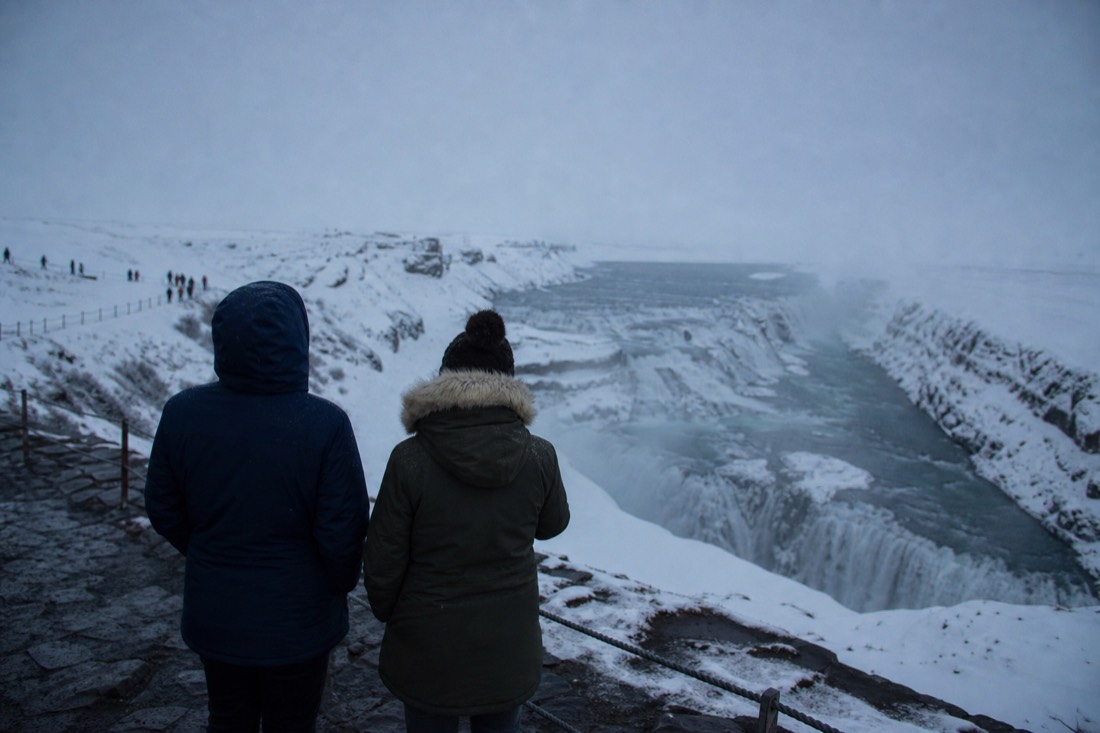
Gullfoss is the one people underestimate. In the cold the spray builds ice along the canyon rim and coats the rocks in the gorge, and on a bright day the whole thing throws light around. What you should expect is that the lower path may be shut. When it is, the upper viewpoint still gives you the full drop and the canyon, and the closure is a safety call rather than an inconvenience someone invented.
What should you not miss on the Golden Circle in winter?
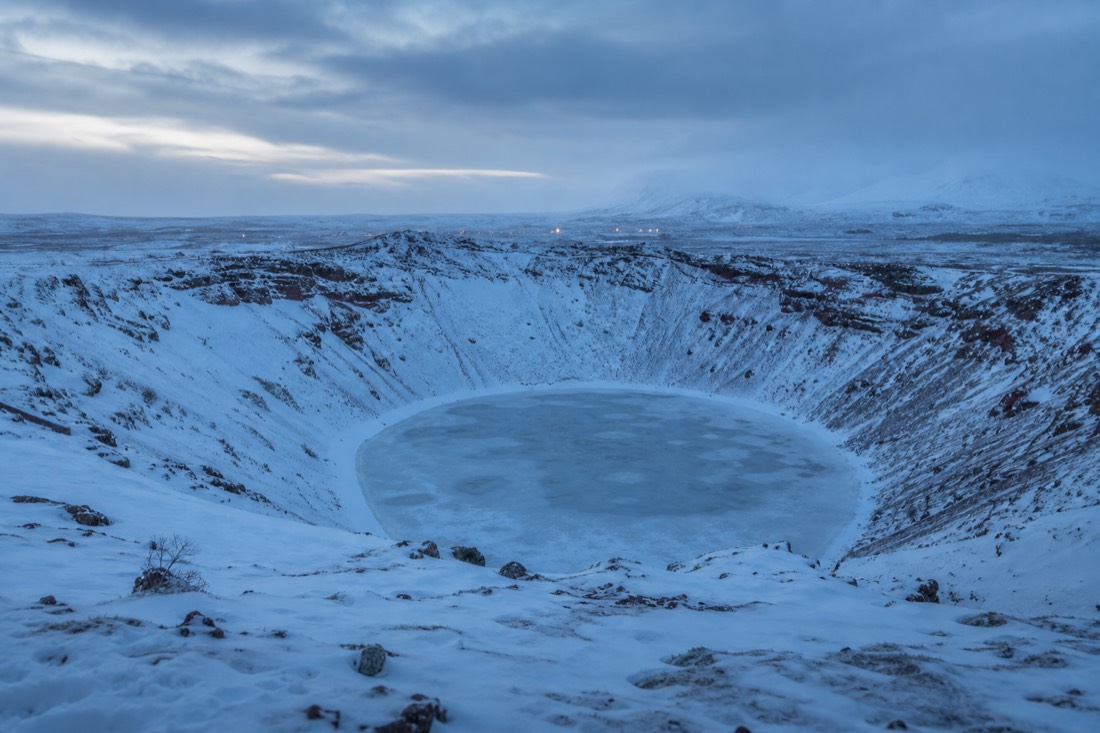
The fourth stop most people skip. Kerið, a volcanic crater with red rims and a lake at the bottom, is remarkable under snow: white rim, dark red rock showing through, and a frozen lake below. It is on the standard route for some operators, an optional add-on for others, and worth checking before you book.
| Stop | What winter changes | The winter catch |
|---|---|---|
| Þingvellir national park | The rift shape reads clearly without summer growth | The Almannagjá path ices over and stays icy |
| Geysir geothermal field | Steam hangs in cold air, eruptions look bigger | Warm ground and ice side by side, stay inside the ropes |
| Gullfoss waterfall | Frozen spray builds along the canyon walls | Lower platforms close when they ice up |
| Kerið crater | Red rim against snow, lake frozen solid | Privately owned, there is a charge at the gate |
Beyond the four stops there is a fifth thing not to miss, which is not a place at all: the light. A Golden Circle day in winter sits almost entirely inside the short daylight window, which means you are seeing all four stops in that long, low, sideways light that Iceland only produces between November and February. Summer visitors get the same route in flat midday sun and think they have seen it.
What you can safely miss is the pressure to add a fifth or sixth stop. Some operators pad the route with a greenhouse, a dairy farm or a small waterfall, and in a winter afternoon that has maybe five hours of usable light, padding costs you time at Gullfoss. Read the stop list before you book, not after.
If you are trying to work out how a Golden Circle day fits alongside the coast and the glacier, how many days you need for an Iceland winter trip sets out the sequence that wastes the least.
Golden Circle or the Ring Road: which is the better winter choice?
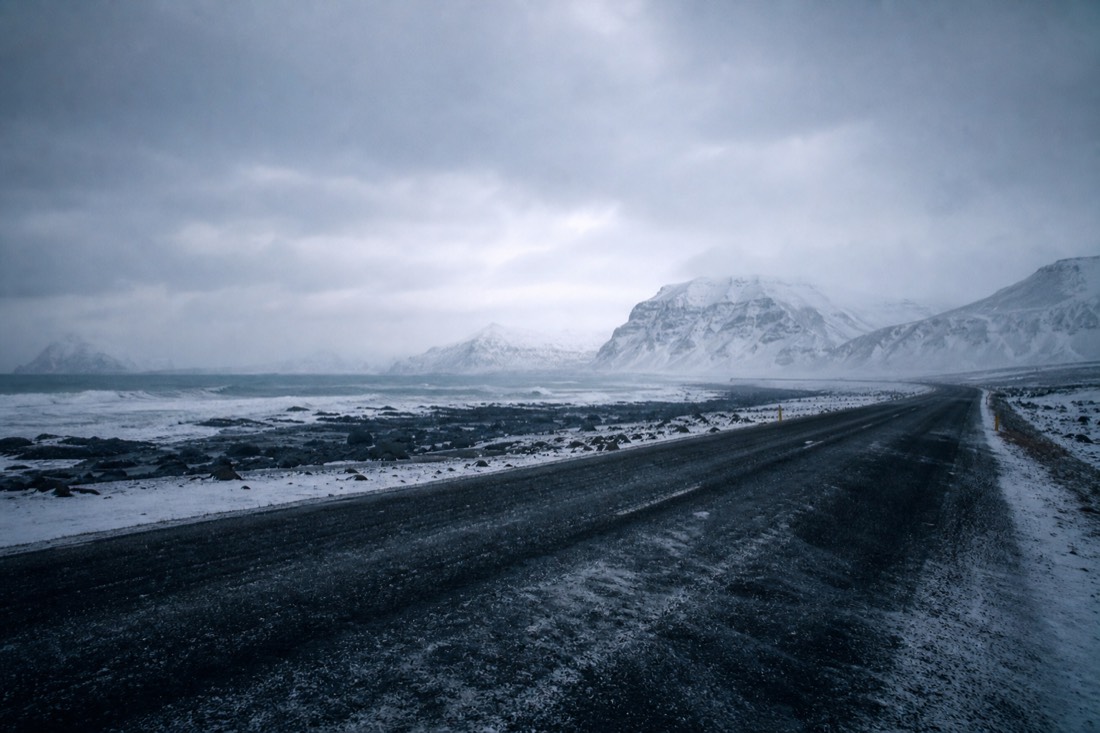
For most winter visitors, the Golden Circle, and it is not close. The Ring Road is the full loop of the country and needs a week at minimum once you factor in winter driving conditions, closures and a daylight window that runs from about four hours in December to about 8.5 in February. The Golden Circle delivers the geology in one 6.5-hour day from your Reykjavík hotel.
| The comparison | Golden Circle in winter | Ring Road in winter |
|---|---|---|
| Time needed | One day, about 6.5 hours guided | A week or more, and that is with luck |
| Distance from the city | Stays in the southwest, never far from help | Whole-country loop, long empty stretches |
| Road treatment | Daily commuter routes, cleared early | Cleared by priority; some sections wait |
| Daylight needed | Fits inside a winter day | Forces long stretches of night driving |
| Cancellation risk | The lowest of any day tour here | Weather can close a leg and strand a schedule |
| What you actually see | Rift valley, geysers, big waterfall, crater | The north and east as well, if conditions allow |
This is not an argument that the Ring Road is a bad trip. It is an argument about the season. Winter takes the two things a Ring Road trip needs most, daylight and predictable road access, and rations both. The highland F-roads are closed for the entire winter, whole sections of the north can shut for a day at a time, and you can check the live picture yourself at road.is or by phoning 1777 on the morning of a drive.
If you have ten days and a stubborn streak, do it with a guide or a package rather than a rental car, and submit a travel plan through safetravel.is. If you have four or five days, do the Golden Circle, do the South Coast, and spend the difference on the winter-only things.
Which Golden Circle tour should you book?
Four are worth comparing, and they differ by what they add rather than by the route. The classic Gray Line day trip is the most-reviewed at 4.5 across 5,583 Viator reviews. The BusTravel afternoon run is the highest-rated at 4.8 across 1,864 GetYourGuide reviews. The other two bolt on snowmobiling or the Blue Lagoon.
| Golden Circle tour | Rating and reviews | Operator | What it adds |
|---|---|---|---|
| Golden Circle classic day trip | 4.5 across 5,583 Viator reviews | Gray Line Iceland | The benchmark, about 6.5 hours, nothing bolted on |
| Best of the Golden Circle, afternoon | 4.8 across 1,864 GetYourGuide reviews | BusTravel Iceland | The highest rated; a later start, so a slow morning |
| Golden Circle and Langjökull snowmobiling | 4.6 across 1,531 Viator reviews | Reykjavík Excursions | Time on a snowmobile on the Langjökull ice cap |
| Golden Circle classic full day | 4.4 across 961 GetYourGuide reviews | ICELANDIA | A full-day pacing with more time at the stops |
The afternoon departure deserves more attention than its review count gets it. In a winter month where the light arrives late anyway, a later start does not cost you sightseeing, it just gives you a morning in Reykjavík and a slightly less brutal alarm. That is why it carries the highest rating of the four.
So if you want the straightforward version with the deepest track record behind it, that is the classic: the Golden Circle tours page compares all four side by side, and the most-reviewed of them, at 4.5 across 5,583 Viator reviews, is available to check for your dates on Viator.
Are the snowmobile and Blue Lagoon combos worth the extra?
The snowmobile combo, yes, if you want a second landscape on the same day: it puts you on top of Langjökull, which the standard loop only shows you from a distance. The Blue Lagoon combo is more about logistics than value, since the lagoon sits on the Reykjanes peninsula on the way to the airport rather than on the loop.
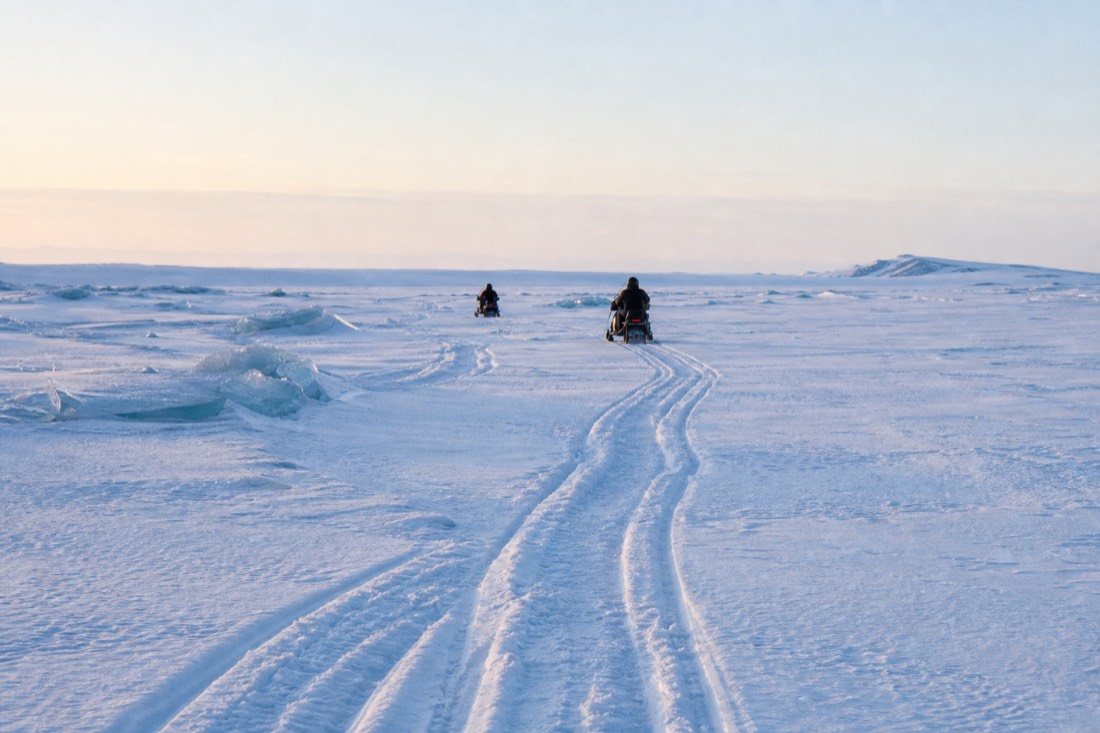
Snowmobiling on Langjökull is a genuinely different thing from the coach day around it. You go up onto the ice cap itself, in a suit and helmet they provide, and the surface is nothing like the postcard: flat white in every direction with almost no depth cues, which is disorienting in a way people do not expect. The combined product bundles it with the loop, and there are also standalone runs from Gullfoss. Both are compared on the snowmobile tours page, where the honest note is that this category has the smallest review counts on the site, so read the terms rather than the ratings.
The Blue Lagoon is the opposite call. Geographically it belongs to your arrival or departure day, not to a Golden Circle day, and pairing them makes for a very long stretch out of one hotel. The lagoon is also the one booking on this site with a two-day cancellation window rather than 24 hours, so it is the least flexible thing you can attach to a weather-dependent day. If it is on your list, treat it as its own outing: the Blue Lagoon and Sky Lagoon transfers page sets out the difference between admission-with-transfer products and the ones that only move you.
One more pairing that people miss entirely: Silfra is at Þingvellir. If snorkelling between two tectonic plates in a drysuit appeals, the Silfra snorkelling tours run year round on the same site the coaches stop at, and they carry the highest ratings anywhere on this site.
What actually closes on the Golden Circle in winter?
Paths, not sites. The route itself stays open in almost any weather, but individual sections get roped off as they ice up: the lower platforms at Gullfoss when frozen spray coats them, parts of the walkway through Almannagjá at Þingvellir, and the steps down inside Kerið. Nothing that closes takes the main view away from you.
This is the part of a winter Golden Circle day that nobody writes into the tour description, and it is worth understanding before you stand in a car park feeling short-changed. These are not closures in the sense of a site shutting its gates. They are individual paths taken out of use because the surface has become genuinely dangerous, usually overnight, and reopened when it is gritted or when it thaws.
Gullfoss is where it matters most, because the walk out along the lower path is the experience people have seen in photographs, and it is also the surface that spray freezes onto first. When it is closed, the upper viewpoint still gives you the entire waterfall, the canyon and the scale. What you lose is the sensation of standing beside it and being rained on by a river.
Þingvellir works the other way around. The main path through the rift is paved, handrailed and mostly open, but it sits in shadow through the middle of winter, so meltwater refreezes on it night after night. Guides send people down it every day. They also watch every single person go down it, because this is the most likely place on the loop for somebody to land badly.
Kerið is the one that catches people out because it is privately run and small, so nobody announces anything. The rim walk is exposed and the way down to the lake gets slick. A frozen crater lake also invites people onto the ice, and that is a decision to leave alone.
| What can close or be restricted | Why | What you still get |
|---|---|---|
| Gullfoss lower platform and path | Frozen spray glazes the surface, and it is above a gorge | The upper viewpoint, the full drop, the whole canyon |
| Sections of the Almannagjá walkway | Shaded, so overnight refreeze builds up | The rift from the top, and the view over Þingvallavatn |
| Boardwalks and side paths at Þingvellir | Snow cover and ice make edges hard to read | The main route, which is the one worth walking anyway |
| The steps down inside Kerið | Steep and unlit, and the surface glazes | The rim view, which is the better photograph in any case |
| Roped ground at Geysir | Hot ground, thin crust, and snow disguising the edges | Strokkur, which is the reason anyone stops there |
| Individual car park bays | Drifting snow and ice at the edges | A shorter walk in, and a guide who parks where it is safe |
Gullfoss deserves its own read, because access there swings with the weather more than anywhere else on the loop, and the answer changes on the same day.
| Conditions that morning | Lower platform | Upper viewpoint | What the falls look like |
|---|---|---|---|
| Cold, dry, little spray drift | Usually walkable, gritted | Open | Ice along the rim, water running hard, best of both |
| Heavy freezing spray | Expect it roped off | Open | The most dramatic version, seen from above |
| Fresh snow overnight | Depends when the crews got there | Open | Soft and white, less ice contrast, very quiet |
| Strong wind | Expect it roped off | Open, but you will not linger | Spray blowing sideways off the lip |
| Mild and wet | Usually open, and muddy rather than icy | Open | Brown water, high volume, less ice on the walls |
How long do you actually get at each stop in winter?
A guided day gives you roughly 40 minutes to an hour at each of the main three, plus half an hour at Kerið if it is on your route. That sounds short and is usually enough in winter, because the walking is slower, the light window is narrow and standing about in a gale loses its appeal quickly.
Stop times are the thing people complain about on any coach tour, so here is the honest version. Allow around an hour for Þingvellir if you want to walk the rift path properly and get back up, and allow more of it than you expect for the walking rather than the looking, because an icy handrailed path is not a stroll. Geysir needs less than people think: Strokkur is on a short cycle, so you will see several eruptions inside half an hour, and the rest of the field is a ten-minute walk.
Gullfoss is where you want your time. If the lower path is open, you need enough of it to walk out, stand there, get wet and walk back. If it is closed, twenty minutes at the upper viewpoint covers it, and the group thins out fast because there is nowhere to shelter.
Kerið is a quick stop by design. The rim view is the shot, the walk round takes as long as you let it, and there is a charge at the gate because the crater is privately owned.
| Stop | Allow, as a planning figure | What fills the time | The winter difference |
|---|---|---|---|
| Þingvellir | About an hour | Walking down the rift, the viewpoint, the church and lake view | Slower going on ice, and less daylight to spend |
| Geysir | 30 to 45 minutes | Two or three Strokkur eruptions, the walk round the field | Steam hangs, so the photographs are better than in summer |
| Gullfoss | 40 minutes to an hour | Upper viewpoint, lower path if open, the walk back up | Access varies by the day, and the wind decides how long you last |
| Kerið | About 30 minutes | The rim walk and the view down to the frozen lake | Ice on the steps, and a charge at the gate |
| Between stops | Driving, in twilight at both ends | Landscape, a guide talking, a stop for coffee | The loop mostly fits the light window, which is its great advantage |
Compare that against a South Coast day, where the driving takes most of the clock and the stops come at you in a rush, and the Golden Circle's proportions look better than its reputation. The whole question of how the two fit together across a trip is worked through in how many days you need in an Icelandic winter, and the light you are working inside is set out month by month in the daylight hours guide.
Who should skip the Golden Circle in winter?
People on a two-day trip who came for the aurora, anyone who has already booked Silfra at Þingvellir, and travellers who want ice above everything else. It is the most reliable day in Icelandic tourism, not the most extraordinary one, and on a short trip reliability can be the wrong thing to optimise for.
I recommend this loop constantly and I still think a decent number of people should not spend a winter day on it. The reasoning is about scarcity. If you have five days, the Golden Circle costs you very little and gives you geology you cannot see anywhere else on that timescale. If you have two, and one of them is already committed to travel, then a day spent on the sights closest to Reykjavík is a day not spent on the glacier country that made you book the flight.
The Silfra overlap is the one people miss until they are standing there twice. The Silfra snorkelling tours run at Þingvellir, on the same site the coaches stop at, so a Silfra day already puts you in the national park with time to walk it. Booking both means seeing the rift twice and the geysers once.
There is also a fair case for skipping it on grounds of footing. If ice underfoot is a real concern, this loop asks more of you than it looks like it will: shaded paths, steps and viewpoints above water. Nobody is going to stop you, and the sites are not dangerous when treated sensibly, but the packing guide section on traction is not decoration on this particular day.
| If this is you | Skip it? | Better use of the day |
|---|---|---|
| Two days in Iceland, aurora is the reason you came | Yes | An evening on a northern lights tour and a day near town |
| You have already booked Silfra | Probably | You will see Þingvellir anyway; spend the day on the south coast |
| Ice and glaciers are the whole point of your trip | Yes | An ice cave tour or a glacier hike |
| You did the loop in summer and want something new | Partly | Do it again only for the winter light, otherwise go east |
| Ice underfoot is a genuine worry for you | No, but prepare | Bring grips, use the upper viewpoints, take the paved routes |
| Five days or more in winter | No | It is the most cancellation-proof day you will book |
| The forecast is ugly and everything east is off | Definitely not | This is exactly the day it exists for |
| You want a second landscape in one outing | No | Take the version with snowmobiling on Langjökull attached |
The honest summary is that the Golden Circle is rarely the best day of an Icelandic winter trip and is very often the one that saves it. That is a different kind of value, and it is why it belongs on almost every itinerary of four days or longer, and on very few two-day ones. What the season trades away and what it hands back is compared properly in Iceland in winter versus summer.
Can you drive the Golden Circle yourself in winter?
You can, and plenty do, but it is a different decision from driving it in July. The roads are surfaced and cleared early, the loop is short, and the risk is not the route but the conditions on any given morning. Check road.is before you leave, and accept that a red wind warning means you do not go.
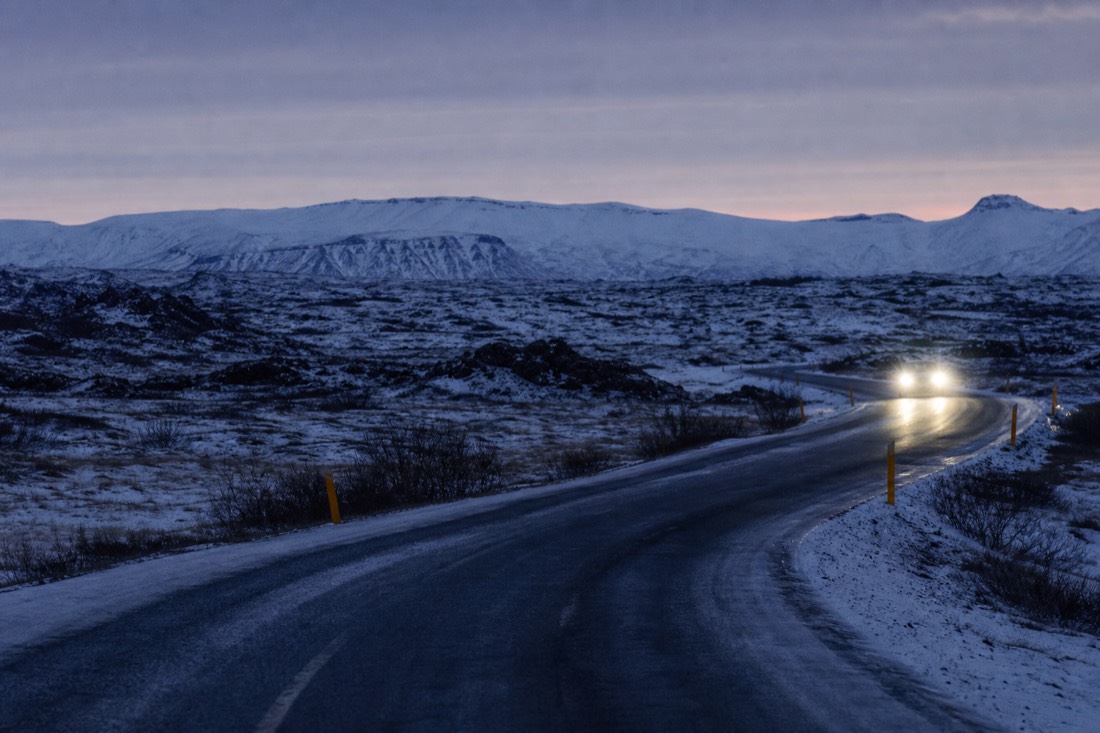
The practical case for self-driving is time at the stops. A coach gives everyone the same forty minutes at Gullfoss whether the light is doing something extraordinary or not, and your own car does not. In a month with five hours of light that flexibility is worth something real.
The case against is narrower than people think, and it comes down to two things. First, ice on a road you cannot read: black ice on the approach to Þingvellir looks exactly like wet tarmac, and a studded winter tyre helps you far more than confidence does. Second, the cost of getting it wrong, since a rental excess in Iceland is not a small number and wind damage to a car door is a famous local claim.
If you do drive it, the rules are simple. Studded tyres are legal from 1 November to 15 April and your rental should already have them, the highland roads are shut regardless of what your map app suggests, and you check conditions on the morning rather than the night before. If you would rather not think about any of that on holiday, a guided seat costs less than the excess on most rental agreements.
A guided day also fails better. When the weather takes a booking off the board, the operator reschedules or refunds it, which is a very different afternoon from sitting in a rental car deciding whether to risk it. The day the weather cancelled everything covers what that actually looks like from the inside, and who we are and how we judge these tours explains why we rate operators on their cancellation behaviour rather than on their photographs.
Golden Circle Classic Day Tour from Reykjavik
Have a date in mind for the loop? Check the classic's calendar before you plan around it: it runs on the days the eastern trips cancel, and it moves free up to 24 hours out if yours turns red too.
6h 30m · de, fi · Hotel pickup offered; details on the listing
Scheduled departure dates. Availability and final price are confirmed on Viator.
None of these experiences matches that choice. Adjust your preference or reset to the general recommendation.
Compare Options And Plan Your Trip
- The benchmark classic
- The deepest track record of the four, about 6.5 hours.
- A later start, highest rated
- 4.8 across 1,864 reviews and a slow morning to go with it.
- The loop plus Langjökull
- A second landscape on the same day, on the ice cap itself.
- Full-day pacing
- More minutes at each stop, ICELANDIA's 4.4 across 961 reviews.
Before Booking
Wheelchair accessible Foldable wheelchairs can be accommodated providing the passenger is accompanied by someone who can assist them board and disembark. However be prepared for uneven surfaces at the sites visited which may be difficult for those with walking disabilities or using a wheelchair Not included: Food and drinks, unless specified; Headphones for the audio guide